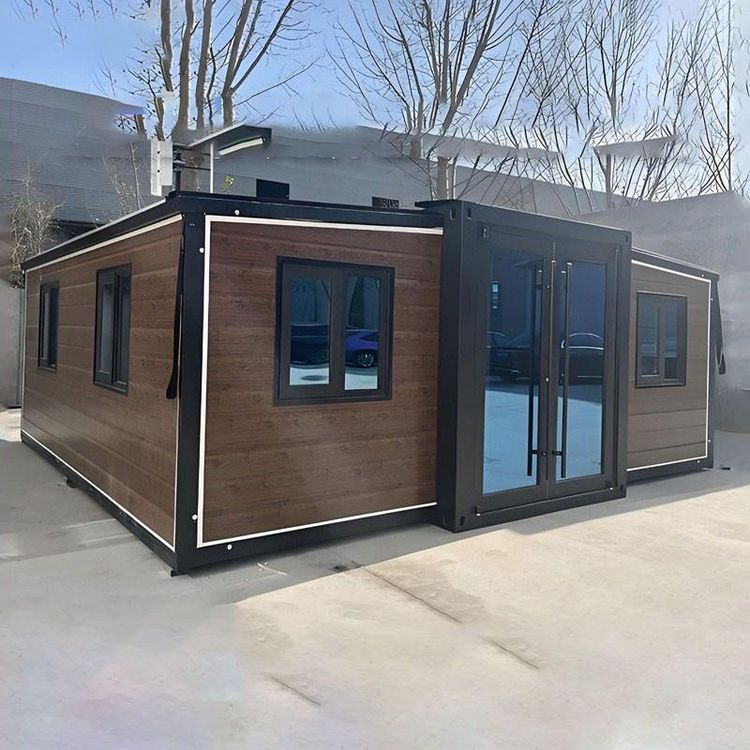
Modular Prefabricated Housing
Prefabricated housing is a construction model that breaks down buildings into independent modules, which are prefabricated in factories and then transported to the site for assembly. Its core features and advantages are as follows:

1. Standardized and Modular Production
Prefabricated housing involves dividing buildings into independent modules and completing the entire process of manufacturing and installation, including the building's main structure, enclosure, equipment pipelines, and interior decoration, within the factory. For example, ceilings, floors, and water and electricity pipelines are all prefabricated on assembly lines, and wooden structural components are precisely processed and then directly transported to the site. This standardized production model ensures uniform precision and quality of each component, avoiding errors caused by manual operation differences in traditional on-site construction, and providing controllable assurance for building quality.
2. Significantly Shortened Construction Period
The factory-based production of prefabricated modules and on-site assembly can be carried out in parallel, greatly reducing the construction cycle. Taking rural houses as an example, using prefabrication technology can complete the main structure construction within 14 days, with the total construction period shortened by about 50% compared to traditional methods; the overall construction period is shortened by more than 60%. This efficiency improvement stems from the continuous operation in the factory, unaffected by weather conditions, and the simple assembly required for on-site assembly, making it particularly suitable for projects with tight deadlines.
3. Seismic Performance and Environmental Advantages
Prefabricated modules optimize structural strength through overall design, and their connection nodes use high-strength materials and processes, significantly improving the building's seismic performance. At the same time, factory-based production can reduce construction waste by about 80%, lowering pollution such as dust and noise, and meeting green building standards. In addition, modular design facilitates later maintenance and upgrades. For example, when replacing damaged components or adjusting the spatial layout, no large-scale demolition or modification is required, extending the building's service life.
4. Wide Range of Application Scenarios
Prefabricated housing technology has been widely applied in civil construction fields such as residential buildings, schools, and hospitals. Its flexibility supports diverse design requirements, enabling the rapid construction of low-cost rural houses as well as the construction of complex multi-story public buildings. For example, school projects can quickly complete the construction of teaching buildings and dormitories through prefabricated modules to meet urgent educational needs; hospital projects utilize modular design to achieve rapid adjustment of functional areas, enhancing emergency response capabilities.
5. Quality Control and Cost Optimization
Factory-based production ensures the quality stability of building components through standardized processes and strict quality inspections. At the same time, mass production reduces material waste and labor costs, offering long-term economic advantages. Although the initial equipment investment is relatively high, considering factors such as shortened construction periods and reduced maintenance costs, the overall cost-effectiveness is superior to traditional construction methods.