
Mobile Toilets for Parks
Mobile toilets for parks are facilities that can be moved as a whole and provide public toilet services. They have advantages such as mobility, modularity, and ease of transportation, with a wide variety of styles and classification methods.
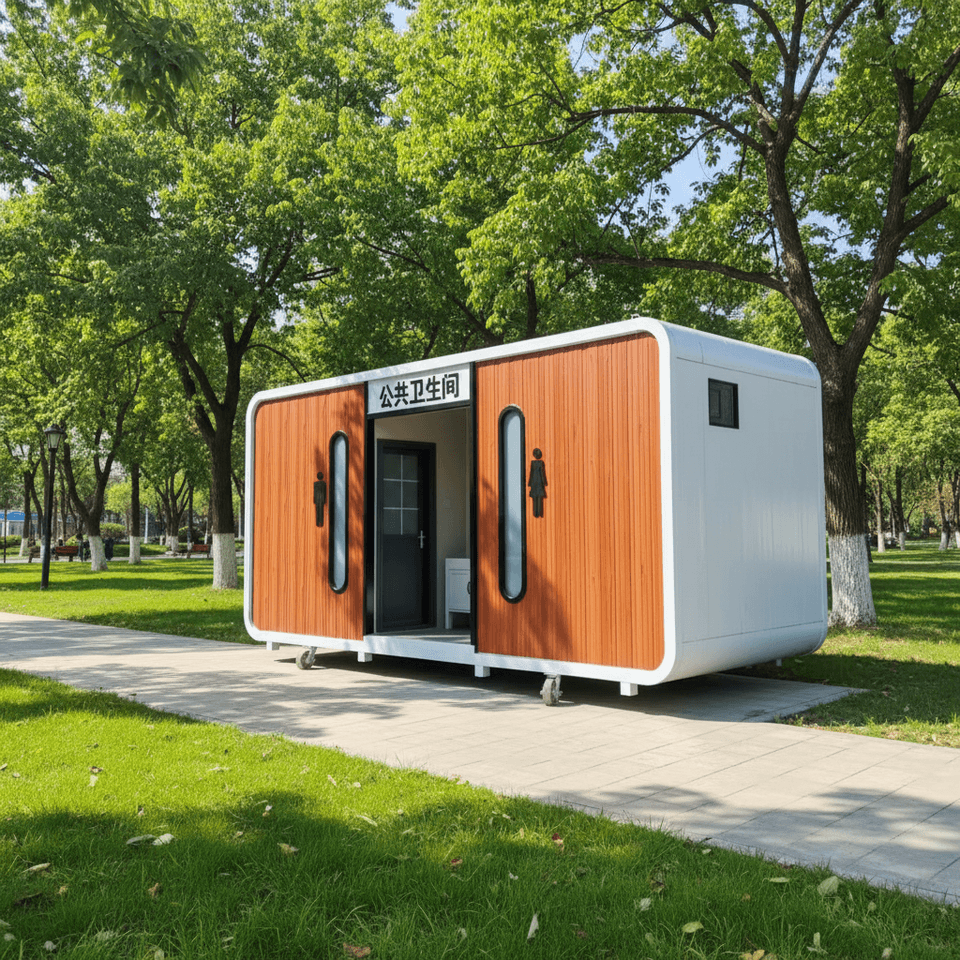
I. Basic Definition and Characteristics Mobile toilets for parks are facilities that can be moved in their entirety and can be placed in park locations with fixed or temporary needs. Their core advantage lies in their reusability, allowing for rapid deployment to target locations via vehicle transportation to adapt to the dynamic changes in tourist flow in scenic spots. For example, during holidays when there is a surge in tourists, temporary mobile toilets can be added to alleviate pressure, and they can be removed after the event to avoid resource idleness.
II. Structural Composition Mobile toilets are composed of six core modules:
- Fecal Treatment System: This includes storage tanks or disposal devices. Water-flush toilets require a septic tank, while non-water-flush toilets use dry-packing technology.
- Basic Structure: The floor uses anti-slip materials, the walls are made of lightweight composite panels or metal frames, and the roof has waterproofing capabilities.
- Sanitary Facilities: These include squat/sit toilets, washbasins, and intelligent sensor flushing systems.
- Auxiliary Systems: Water tanks provide flushing water, ventilation systems maintain internal air quality, and intelligent disinfection devices regularly sterilize.
- Mobile Devices: Wheels or lifting rings are installed at the bottom to support transportation methods such as forklifts and trailers.
- Energy Modules: Some high-end models are equipped with solar panels or batteries to enable off-grid power supply.
III. Classification Methods
- By Structural Form:
- Single-unit Structure: Independent units suitable for narrow spaces.
- Composite Structure: Modular combinations that can be expanded into large facilities with multiple toilet stalls.
- By Mobility Method:
- Lifting Type: Hoisted by cranes, suitable for long-term fixed positions.
- Trailer Type: Equipped with their own axles and can be towed by vehicles.
- Handling Type: Moved by forklifts or manually, suitable for short-distance adjustments.
- By Sewage Treatment:
- Water-flush Type: Requires connection to municipal sewage networks or regular pumping of septic tanks.
- Recirculating Water-flush Type: Purifies wastewater through biodegradation technology to achieve water reuse.
- Dry-packing Type: Uses biodegradable film bags to collect feces without the need for flushing, suitable for areas without water sources.
IV. Typical Models
- Classic Model: Flat-top design with a white and coffee color scheme, double-door structure, and equipped with basic sanitary facilities, suitable for general park scenarios.
- Micro-intelligent Model: 1.15 meters wide and 2.45 meters high, integrating air conditioning, ventilation systems, and intelligent lighting control, with remote monitoring via the Internet of Things.
- Apple Pod Model: Four squat stalls without gender separation, with an external wash area to improve usage efficiency, and a novel design that has become a popular spot for taking photos in scenic spots.
You may also like

Portable Toilet Rental for Construction Sites: What to Consider
Read More
Portable Toilet Rental Price Guide: Budget, Mid-Range & Premium
Read More
Portable Toilet Color Steel: A Practical Buyer's Guide
Read More