Mobile Toilet Sewage Discharge
There are various methods for sewage discharge in mobile toilets, commonly including conventional water-flushing, vacuum sewage systems, water-storage sewage systems, direct water-flushing systems, and those equipped with built-in fecal and water tanks.

Conventional water-flushing mobile toilets require connection to water supply and drainage pipes. They discharge sewage through manual or automatic sensing to septic tanks or municipal sewage networks. This method is suitable for various water-rich environments, such as city streets and parks. It has relatively low construction costs and good sewage discharge effects but relies on municipal water supply and drainage systems.
Vacuum sewage systems utilize negative pressure principles, using vacuum pumps to suck sewage and waste into collection containers. When the sewage reaches a preset level, the vacuum pump automatically starts to discharge the waste. This system is highly efficient, uses less water, and effectively prevents sewage leakage and odor diffusion. It is suitable for places with high hygiene requirements, such as high-end scenic spots and large event venues.
Water-storage sewage systems flush waste into storage tanks through water flushing. When the sewage reaches a preset level, the flushing device automatically starts to flush the waste into the storage tank. The storage tank needs to be cleaned and replaced when full, making it suitable for places with sufficient water sources and easy cleaning, such as construction sites and temporary camps.
Direct water-flushing systems use water tanks or external water sources for flushing, with sewage directly discharged into collection tanks or septic tanks below. This method is suitable for construction sites, large events, or temporary camps with fixed collection cycles. It provides thorough flushing but requires regular cleaning of the sewage tanks. However, the water tank capacity is limited, and pipes are prone to freezing in cold regions, affecting usage.
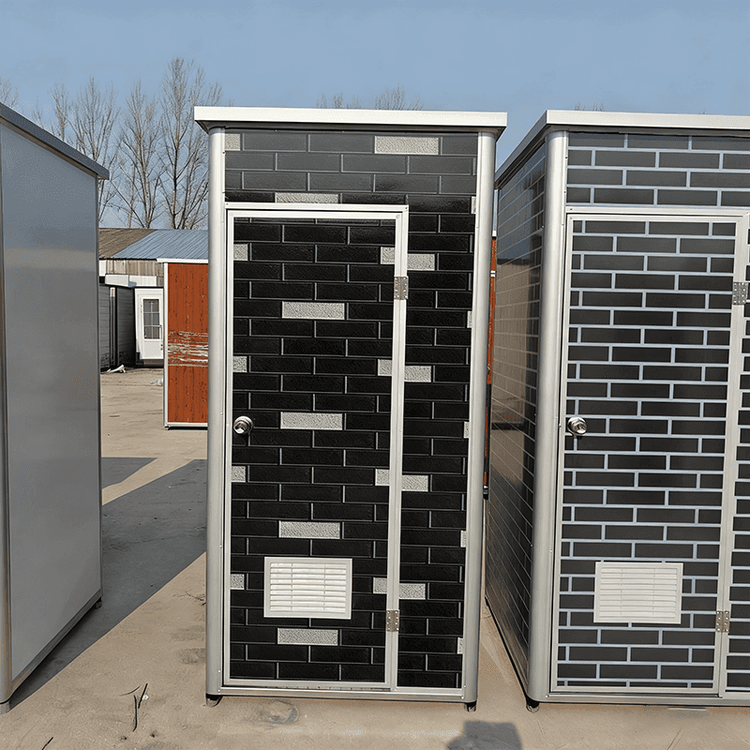
Some mobile toilets come with built-in fecal and water tanks, eliminating the need for septic tanks or water and electricity connections. For example, a mobile toilet measuring 1.1 meters in length, 1.1 meters in width, and 2.3 meters in height, made of polyethylene plastic, is equipped with a foot-operated squat toilet, with a fecal tank below. This method is flexible and convenient, suitable for remote areas without water and electricity supply or temporary usage scenarios.