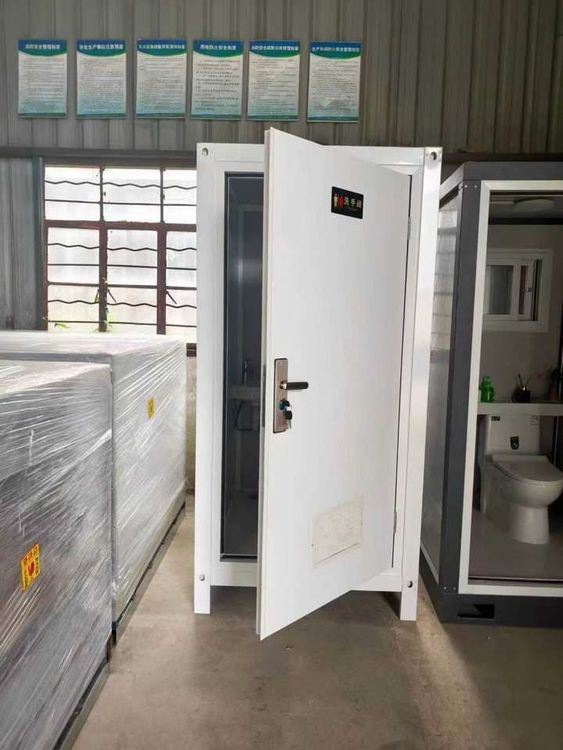
Mobile Toilet Restroom
A mobile toilet is a facility that can be moved as a whole and provides toilet services to the public, with advantages such as mobility, modularity, and ease of transportation.

I. Basic Composition A mobile toilet generally consists of a fecal sewage storage tank (or disposal unit), flooring, sanitary fixtures, walls, washing equipment, water tanks, roofs, and mobile devices. Among them, the fecal sewage storage tank is used to collect excreta, sanitary fixtures include toilets or squat pans, washing equipment such as sinks provides cleaning functions, and mobile devices ensure that it can be transported to different locations.
II. Classification Methods
- By structural form: It is divided into single-structure mobile toilets (independent units) and composite-structure mobile toilets (multi-unit combinations).
- By mobility method: It includes lifting and handling types (requiring manual or mechanical handling) and powered and towed types (which can be towed by vehicles or have their own power for movement).
- By sewage treatment method:
- Water-flush and waterless-flush suction types: They rely on a water source for flushing, and excreta is processed through suction equipment; the waterless-flush type directly sucks up excreta and is suitable for water-scarce environments.
- Recirculating water-flush type: It recycles water resources through filtration and disinfection technologies, reducing water consumption.
- Dry-packing type: It uses biodegradable bags to collect excreta, requiring no water source, and is suitable for remote areas or temporary events.
III. Core Features The core advantages of mobile toilets lie in their flexibility and reusability. They can be quickly deployed to fixed or temporary demand locations such as stations, docks, tourist attractions, large construction sites, and squares, and can adjust the quantity or combination form according to the flow of people. For example, a mobile toilet on a scenic commercial street may adopt a design that is 10 meters long and 3 meters wide, with the women's toilet having 7 stalls and 2 sinks, and the men's toilet having 3 urinals and 1 cleaning sink; customized models may adopt steel structural frames, metal carved panel exteriors, and be equipped with lighting and ventilation windows and independent rooms, balancing durability and comfort.
IV. Application Scenarios Mobile toilets are widely applicable to densely populated public places (such as commercial streets and exhibitions) and temporary events (such as music festivals and construction projects). Their modular design allows for quick installation and disassembly, effectively solving the problems of long construction periods and high costs associated with traditional toilets, while meeting environmental protection and hygiene requirements.