Mobile Toilet Production Equipment
Mobile toilet production equipment mainly involves processing and transforming basic materials to construct the toilet body and related facilities, commonly using materials such as water storage tanks for production.

Basic Materials and Tools
When producing mobile toilets, basic materials are essential. Taking the common production of mobile toilets using water storage tanks as an example, the water storage tank is the core material, providing a certain space for storing fecal sewage and the like. Additionally, wooden boards are required for constructing the frame structure, such as fixing universal wheels at the four corners of the wooden boards to facilitate the overall movement of the mobile toilet. Wooden strips are also frequently used, fixed to the upper side of the tank with self-tapping screws to increase height and provide support for the subsequent installation of other components. In terms of tools, an angle grinder is a key piece of equipment. A worker uses an angle grinder to split the water storage tank in half, which is an important step in the initial transformation of the tank. Self-tapping screws are used to fix wooden strips, wooden boards, and other components to ensure structural stability.
Main Body Structure Production
When producing the main body of the mobile toilet, first divide the water storage tank to obtain a suitable spatial structure. Then, install universal wheels at the four corners of the wooden board to achieve mobility. Use wooden strips to increase the height on the upper side of the water storage tank to prepare for the subsequent installation of components such as the roof. Open a doorway on the side of the water storage tank, install sponge strips to form a door frame, and embed plastic soft boards to create an elevated wall, which ensures the toilet's closure while providing a certain degree of flexibility. Place the upper half of the water storage tank on top of the wooden strips to form the roof, completing the construction of the main frame.
Installation of Supporting Facilities
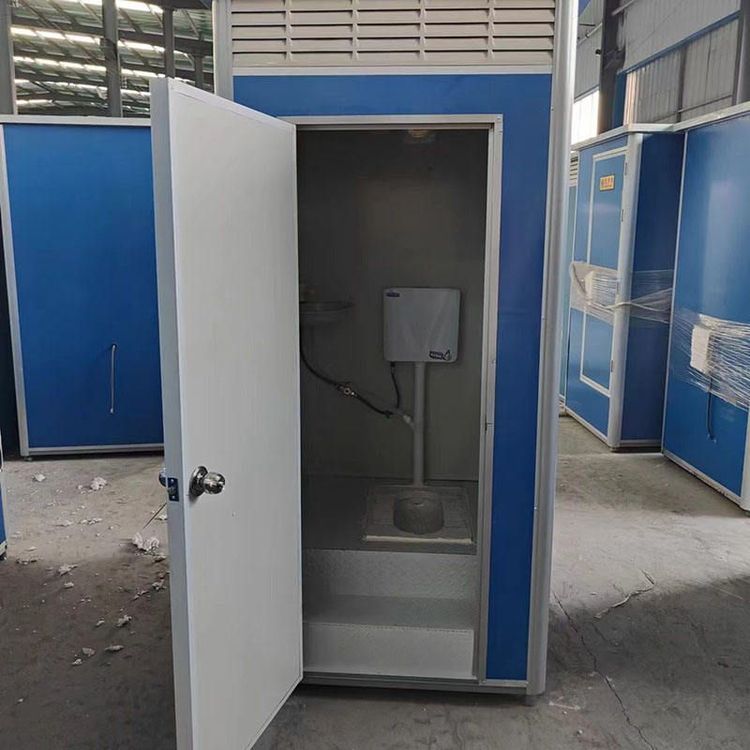
After the main body structure is completed, supporting facilities need to be installed. Drain pipes are used to discharge sewage from the toilet, ensuring internal cleanliness and hygiene. Bathroom heaters can provide warmth in cold weather, enhancing user comfort. Toilets and washbasins are the basic sanitary fixtures in mobile toilets, meeting people's needs for defecation and washing. There are also cases of using water storage tanks to produce solar-powered mobile toilets, which require the additional installation of solar panels and related equipment. Solar energy is used to provide power for the toilet's lighting, ventilation, and other systems, achieving energy conservation and environmental protection.