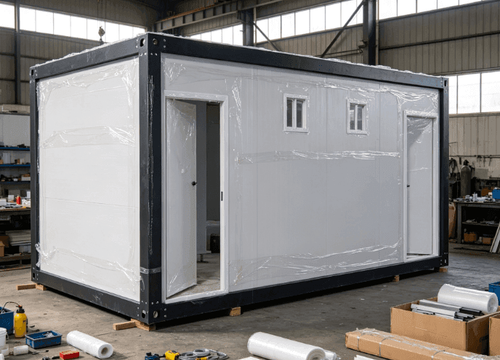
Mobile Sanitation Toilet
A mobile sanitation toilet is a public health facility designed based on new materials and water-saving technologies, featuring water conservation, durability, hygiene, and wide applicability.

1. Water-saving technology
Mobile sanitation toilets achieve efficient water conservation by automatically collecting hand-washing water and adding special agents. The flushing effect requires only 0.46 liters of water per person, significantly lower than the water consumption of traditional public toilets. This technology reduces water pressure in public places by optimizing water resource recycling, making it particularly suitable for water-scarce areas or temporary event scenarios.
2. Structure and materials
The toilet frame is welded using national standard steel, ensuring structural stability. The surface is covered with anti-corrosion and fire-resistant materials such as color-coated steel plates or carved panels, extending the service life (up to over 20 years) and enhancing safety. Internally, it is equipped with an independent urinal and fecal pit partitioned treatment system: the urine channel utilizes gravity-driven flow design to reduce mechanical failure risks, while the fecal channel is cleaned by a piston-type scraper mechanical device to prevent blockages. Additionally, the provision of anti-slip floors, automatic flushing toilet bowls, and ventilation and lighting systems further enhances user comfort and hygiene standards, complying with the GBLT18091-92 national standard.
3. Technological routes and product forms
Since 2012, mobile public toilet technology has gradually evolved, forming three major technological routes: waterless flushing (relying on biodegradation or chemical sealing), foam sealing (reducing odors through foam coverage), and water flushing (optimizing the flushing process with water-saving technologies). Product forms cover antique-style (suitable for cultural scenic spots), temporary construction site models (meeting short-term high-intensity usage demands), marine models (adapted to humid environments), and other niche categories, supporting vehicle-mounted mobility or traditional public toilet renovations. Diverse forms such as trailer-mounted, box-type substation cabinet-style, and stainless steel booth-style further expand their application flexibility.
4. Application scenarios and industrial chain
Mobile sanitation toilets have been widely used in public places such as scenic spots, service areas, and rural areas, addressing issues like long construction periods and site selection limitations of traditional public toilets. The industrial chain involves over 20 manufacturing enterprises in Liaoning, Shanghai, Hebei, and other regions, providing solutions such as prefabricated and eco-friendly water-saving models, driving the industry towards standardization and modularization. Continuous technological iterations and form innovations meet public health demands across various scenarios.