Mobile Plastic Toilet Capacity
The capacity of mobile plastic toilets needs to be comprehensively considered from two dimensions: water tank capacity and usage frequency, as well as internal space capacity. Specific data varies depending on the model and design.

I. Water Tank Capacity and Usage Frequency
Currently, publicly available information does not directly indicate the capacity of blue plastic mobile toilets, but it can be indirectly estimated through the flushing volume parameters of similar products.
- Small-scale equipment: If equipped with a 15-liter water storage tank, the number of uses varies significantly depending on the single flush mode. For example, with a 0.5-liter micro-flush mode, it can theoretically support 30 flushes; if using a 5-liter full-flush mode, it only supports 3 flushes. Such designs are mostly used in temporary events or scenarios with low foot traffic, extending usage time through water-saving modes.
- Common models in Zhengzhou: The water tank capacities of plastic mobile toilets in Zhengzhou are mostly between 100-200 liters, with a single flush supporting 5-10 uses. For example, a 100-liter water tank can support 10 uses if flushed with 10 liters per time; if flushed with 20 liters per time, it only supports 5 uses. The specific number of uses needs to be adjusted according to the ratio of water tank capacity to single flush volume. Some models reduce water consumption by optimizing the flushing system (such as vacuum suction or foam sealing technology), thereby increasing the number of uses per water tank.
II. Internal Space Capacity
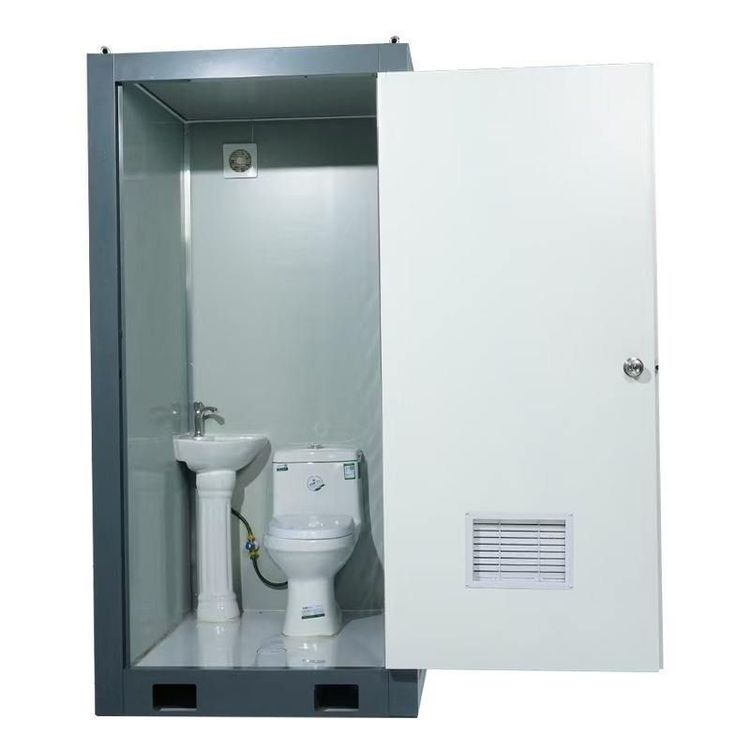
The internal space design of standard single-person plastic mobile toilets focuses on meeting the needs of a single user, with a capacity typically ranging from 0.5 to 0.8 square meters.
- Space layout: This area can accommodate one person standing or squatting, with basic activity space reserved (such as turning around and organizing clothing). Some models further save space by optimizing the structure (such as folding doors and built-in storage racks), but the dimensions of core functional areas (such as toilets and flushing devices) must comply with ergonomic standards to ensure user comfort.
- Applicable scenarios: Such designs are suitable for scenic spots, construction sites, temporary exhibitions, and other scenarios, meeting basic needs while facilitating transportation and rapid deployment. If multiple people need to use it simultaneously or barrier-free facilities (such as wheelchair access) are required, larger capacity models (such as double rooms or family rooms) need to be selected.
Summary: The capacity of mobile plastic toilets needs to be comprehensively evaluated by combining water tank capacity (determining usage frequency) and internal space (determining occupancy). Users should match the corresponding model according to the actual usage scenario (such as foot traffic, usage frequency, and space constraints) and obtain specific parameters (such as water tank capacity, single flush volume, and internal dimensions) by consulting suppliers to optimize decision-making.