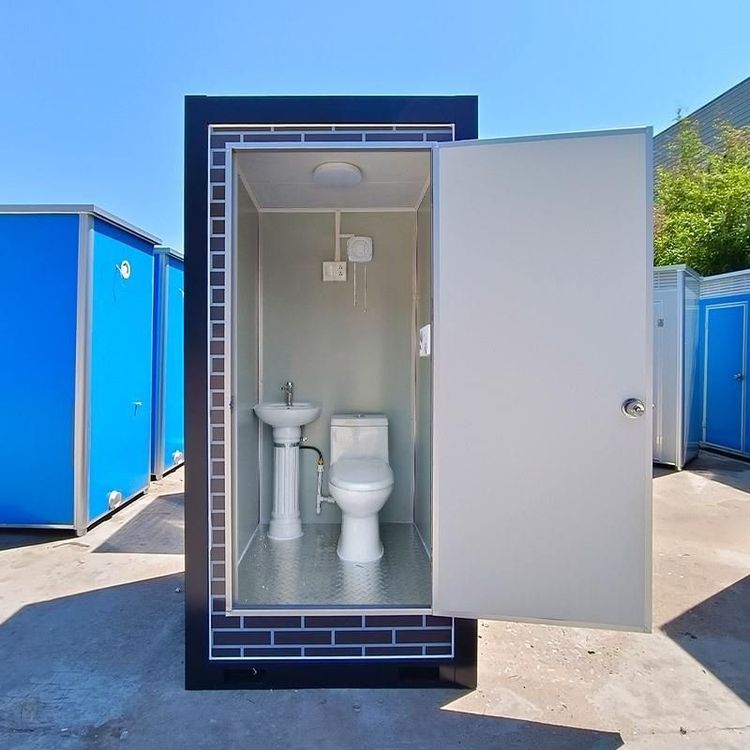
Mobile Men's Toilet
Mobile men's toilets generally refer to toilet facilities that are movable and specifically designed for men, or types of mobile toilets that achieve male-specific functions through dynamic adjustments. The following provides an explanation from the aspects of definition, structure, mobility methods, and special types:

1. Basic Definition and Functions
A portable toilet is a movable facility designed to meet toilet needs in temporary or fixed locations, with its core function being to provide sanitation services to the public. As a type of portable toilet, men's toilets are usually equipped with male-specific sanitary fixtures (such as urinals, toilets, or squat toilets) and have separate entrances to distinguish genders. For example, in conventional portable toilets, men's and women's toilets are separated by walls, with clear signs (such as 'Men's Toilet') hung at the entrances, and the interior is equipped with facilities that conform to male physiological characteristics.
2. Structure and Mobility Methods
The structural design of portable toilets directly affects their mobility and applicable scenarios:
- Structural Forms: They are divided into single-unit structures (independent units suitable for small-scale needs) and composite structures (multiple units combined, suitable for large-scale events or scenic spots).
- Mobility Methods: These include hoisting types (requiring lifting equipment for transportation), handling types (moved manually or by small machinery), powered types (with built-in driving devices, such as electric trailers), and towed types (can be connected to vehicles for towing). Men's toilets can choose the corresponding type according to needs. For example, a hoisting-type single-unit men's toilet may be used for temporary exhibitions, while a towed composite-structure toilet may be used at highway service areas.
3. Special Type: Dynamic Adjustment of Tidal Toilets
Some portable toilets achieve gender area conversion through flexible design to cope with peak toilet usage. For example, the 'Tidal Toilet' in Huizhou West Lake Scenic Area, Guangdong:
- Basic Layout: Under normal conditions, the men's toilet is on the right side of the entrance, separated from the tidal area by an openable iron gate.
- Dynamic Adjustment: During peak periods, the iron gate is closed, and the tidal area (including gender-neutral toilet stalls) is temporarily converted into a female-only area. The usage rights are updated through movable signs or lockable sliding doors. At this time, the original men's toilet area may be reduced or remain unchanged, depending on the proportion of foot traffic.
- Technical Support: It relies on physical separation facilities (such as iron gates) and signage systems to ensure that the adjusted areas meet hygiene and privacy requirements.
4. Adaptability of Sewage Treatment Methods
The mobility of men's toilets needs to be matched with sewage treatment methods:
- Flush Types: These require a connection to a water source or the provision of a water tank, suitable for scenarios with a water supply (such as city parks).
- Waterless Suction Types: These use vacuum pumps to suction feces into storage tanks for regular removal, suitable for water-scarce areas (such as desert scenic spots).
- Dry Packing Types: These use biodegradable bags to collect feces, requiring no water source, suitable for events with high environmental protection requirements (such as music festivals).
Mobile men's toilets effectively meet temporary toilet needs through modular design, diverse mobility methods, and dynamic adjustment functions, playing an important role especially in scenarios with high foot traffic or inadequate infrastructure.