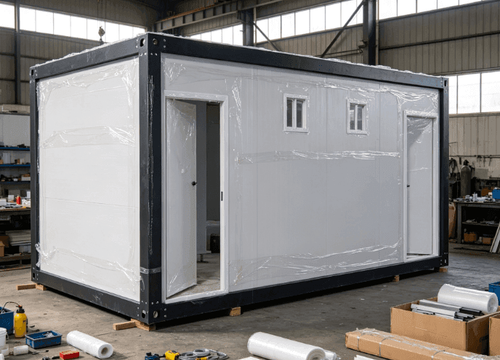
Mobile Marine Toilet
For insights into mobile marine toilets, one can refer to the toilet facilities on the USS Ford aircraft carrier, which employs a vacuum sewage system but faces frequent malfunctions and maintenance challenges.

As a large-scale mobile maritime platform, the USS Ford's toilet system design must meet the needs of high-density personnel usage. The ship is equipped with approximately 650 toilets, utilizing vacuum sewage technology to draw sewage through negative pressure to a centralized treatment system. This design theoretically reduces water consumption and the risk of pipe blockages, but multiple flaws have been exposed during actual operation.
First, system reliability is inadequate. The core of the vacuum sewage system relies on the coordinated operation of valves and suction devices, but the USS Ford has experienced instances where valve failures caused entire sections of toilets to lose suction. For example, a single malfunctioning valve could render dozens of adjacent toilets unusable, and troubleshooting requires inspecting pipe segments one by one, resulting in low maintenance efficiency. Additionally, the accumulation of calcifications in narrow pipes is a significant issue, as minerals from seawater form deposits on pipe walls, further reducing flow cross-sections and exacerbating blockage risks.
Second, maintenance and emergency response capabilities are weak. Since its overseas deployment in June 2025, the USS Ford has faced repeated severe blockages in its toilet and sewage systems, even experiencing sewage backflow. The ship was filled with a pungent odor, and crew members had to wait in line for 30 to 40 minutes to use the toilets, severely impacting operational efficiency and living conditions. This reflects that the system design did not adequately consider long-term high-load operation scenarios, lacking redundancy or rapid cleaning mechanisms. For instance, calcification removal requires specialized equipment and downtime for maintenance, while the maritime environment limits maintenance frequency and effectiveness.
Third, design flaws mismatch actual needs. Although the vacuum sewage system performs stably in land-based settings, maritime platforms face unique challenges such as salt spray corrosion and space constraints. The USS Ford's case demonstrates that the system was not optimized for the marine environment, with issues like insufficient corrosion resistance of pipe materials and valve sealing being easily affected by salt. Additionally, high-density personnel usage results in excreta concentrations far exceeding design expectations, accelerating pipe blockages and equipment wear.
In conclusion, mobile marine toilets must balance water conservation, reliability, and maintainability. Lessons from the USS Ford can be used to optimize system design, such as adopting modular piping, enhancing corrosion-resistant materials, and adding backup suction units to improve long-term operational stability.