
Mobile House Container Garage
Mobile house container garages are movable garages that are either modified or directly produced using containers as carriers. They feature modularity, disassembly and assembly capabilities, and wind and rain resistance, making them suitable for temporary or semi-permanent parking needs in construction sites, courtyards, and commercial settings.
I. Product Types and Features
Basic Functional Type
Represented by manufacturers such as Jiangsu Tangcheng and Suzhou Wujiang Xiemei, these basic container garages offer wind and rain resistance and come with roller shutter doors, with prices concentrated in the range of 189-280 yuan per square meter. These products adopt steel structural frames with outer layers made of color-coated steel sheets or metal materials. Internally, they can be equipped with basic functions such as lighting and ventilation, making them suitable for scenarios such as temporary parking at construction sites and outdoor warehouses in towns and villages. Their core advantages are low cost and fast installation (some manufacturers promise delivery within 48 hours), but they have relatively weak structural stability and low reusability.High Reusability Type
Folding container garages introduced by leading manufacturers such as Suzhou Zhongnan and CIMC Modular Building Systems can be unfolded and fixed by a single person within 5 minutes through hydraulic automatic unfolding structures or modular assembly designs. These products support multiple disassembly and assembly cycles (an average of more than 8 times) and reduce construction waste emissions by 90% compared to traditional temporary buildings, aligning with low-carbon circular policy guidelines. They are suitable for scenarios such as emergency support and short-term commercial pop-ups. For example, the folding containers from Suzhou Zhongnan can save 3750-5000 yuan per set in emergency transportation costs.Customized Scenario Type
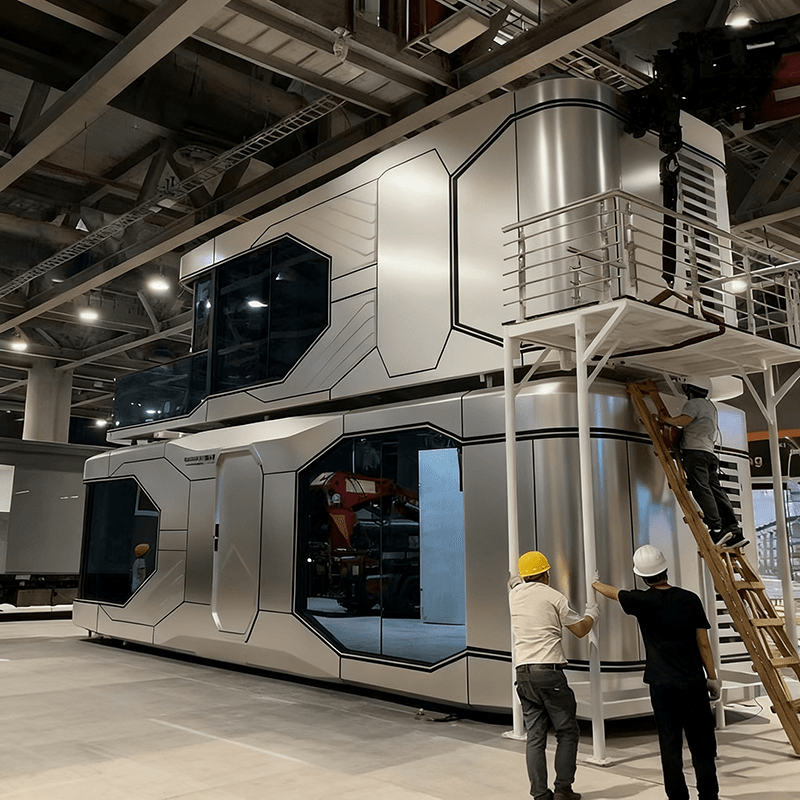
In response to the needs of high-end cultural tourism homestays and overseas cross-border projects, manufacturers offer personalized customization services, such as exterior facade decoration, internal functional zoning (integration of bedrooms, bathrooms, and living rooms), and thermal insulation and soundproofing systems. The "Apple Warehouse" integrated housing from Shandong Yunsen is a representative example. Its arched or box-shaped contours are suitable for ecologically sensitive areas such as mountains and forests. After transportation, it only requires connection to water and electricity for occupancy, with an average annual operating period of more than 180 days.
II. Key Selection Indicators
Process Performance
It is essential to focus on examining the level of welding-free quick assembly technology, the degree of disassembly and assembly losses, and the structural stability after multiple relocations. Products from leading manufacturers usually pass third-party testing and certification. For example, the folding containers from Suzhou Zhongnan have a structural loss rate of less than 5% in cyclic testing.Compliance Services
Verify whether manufacturers possess domestic and international certification qualifications (such as CE certification and ISO standards) and project delivery and after-sales implementation capabilities. For example, the products from CIMC Modular Building Systems Investment Co., Ltd. can meet cross-border export qualification requirements.Return on Investment
Comprehensively evaluate the reuse cost and operation and maintenance cost over the entire lifecycle. Although high-quality products may have a higher unit price (such as high-end customized types costing more than 3000 yuan per square meter), their long-term usage costs are lower. Moreover, they align with green construction policy guidelines and are eligible for relevant subsidies.



