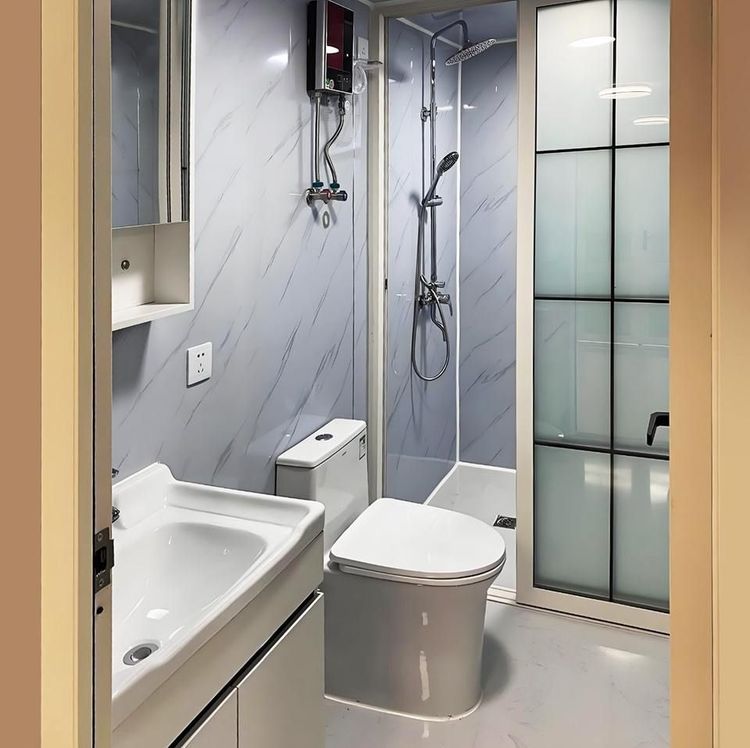
Mobile Harmless Toilet
Mobile harmless toilets generally refer to mobile environmentally friendly public toilets designed based on new materials and water-saving technologies. They are characterized by environmental protection, water conservation, and flexible deployment, and are widely used in public places.

Design Features
The frame of a mobile harmless toilet is welded using national standard steel, and its surface is covered with anti-corrosion and fire-resistant materials such as color-coated steel sheets or carved panels, with a service life of over 20 years. It is equipped with an independent urinal and toilet partition treatment system: the urine channel utilizes gravity flow, while the feces channel is cleaned by a piston-type scraper mechanical device. It also features anti-slip floors, automatic flushing toilets, and ventilation and lighting systems, complying with the GBLT18091-92 standard. The exterior wall materials can be selected according to needs, including color-coated steel sheets, metal carved panels, anti-corrosion wood, stainless steel sheets, or aluminum-plastic panels. The main structure is welded with national standard light steel keels and supports overall hoisting. Standard configurations include toilets (urinals), coat hooks, vanity mirrors, waste bins, lighting fixtures, exhaust fans, door locks, and occupancy indicators; optional configurations include heating and cooling air conditioners, air purifiers, anti-freeze systems, heating systems, background music, hand basins, and water-saving faucets. Its intelligent water-saving technology achieves a flushing effect of approximately 0.46 liters of water per person by automatically collecting urine and hand-washing water and adding water-saving special agents.
Technical Types
- Circulating Water Flush Type: Equipped with intermittent aerobic and anaerobic treatment devices, it adds biological strains and utilizes biofilm technology to accelerate the decomposition of fecal sewage. The treated water can be recycled for flushing.
- Dry Packaging Type: Without a water flushing device, excreta is collected by biodegradable plastic bags, which are automatically replaced and collected for centralized treatment after use.
- Other Types: These include foam sealing types (using foam to seal odors), packaging types (similar to dry packaging but with simplified structures), water-saving flush types (optimizing flushing efficiency), water-free rechargeable types (relying on chemical agents for treatment), and microbial types (utilizing microorganisms to decompose excreta).
Application Scenarios
Suitable for stations, docks, tourist attractions, villa areas, newly built residential areas, large construction sites, squares, densely populated public places, and bustling commercial streets, covering scenic areas, service areas, rural areas, etc. Its modular design facilitates rapid deployment, making it particularly suitable for temporary events or areas lacking fixed sewage systems.
Historical Evolution
Mobile harmless toilets emerged during the third public toilet revolution (from the 1990s to the end of the 20th century). Initially made of wood, they gradually adopted materials such as fiberglass and polyethylene. Modern versions integrate light steel frames and intelligent technologies, becoming an important branch of environmentally friendly public toilets.