Marathon Portable Toilet Information
The setup, design, and support of portable toilets for marathons are as follows:

I. Optimization of Quantity and Distribution
Different marathon events continuously improve the quantity and distribution of portable toilets. Taking the Beijing Marathon as an example, in 2013, 300 squatting positions were set up, but issues such as unreasonable locations and lack of guiding signs were identified. By 2025, the event organizers optimized the distribution using crowd flow models, increasing the number of toilet positions at the starting point from 765 to 1,119, along the course from 121 to 169, and at the finish line from 151 to 161, with a total of 1,449 toilet positions, ensuring reasonable waiting times during peak periods. The Harbin Marathon, however, exposed distribution issues due to weather factors (e.g., increased urine output from runners due to rain and cooling in the 2026 event). Despite the provincial sports bureau stating that the total number of toilet positions was sufficient, supply-demand imbalances persisted in certain areas, necessitating further adjustments based on actual needs.
II. Material and Structural Design
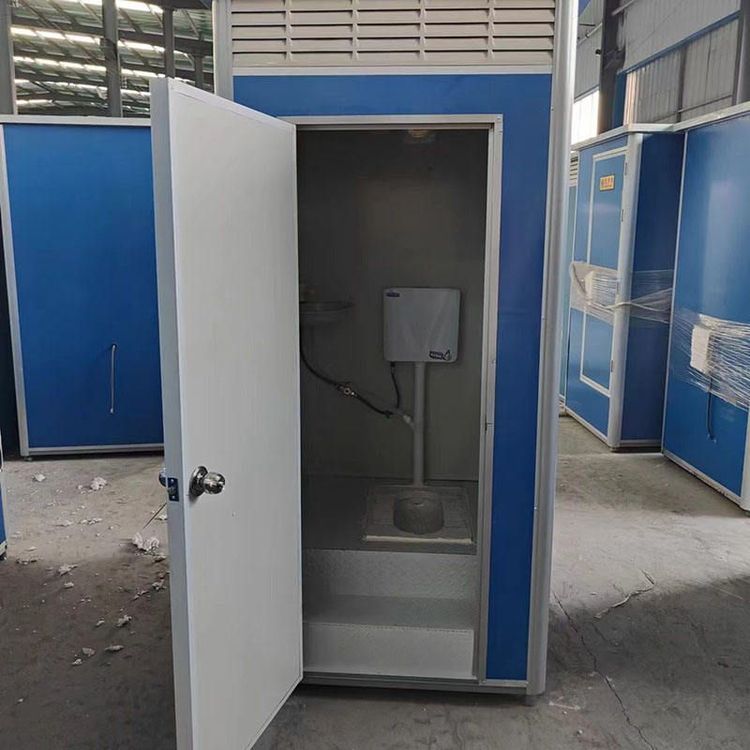
The outer shell of portable toilets is made of fiberglass or polyethylene, offering weather resistance and corrosion resistance suitable for outdoor environments. The internal support frame is constructed from aluminum alloy, balancing load-bearing requirements with rapid assembly and disassembly efficiency. Toilets generally adopt water-saving designs, with single flush volumes controlled below 30% of standard toilets, achieving efficient flushing through siphon principles and pressure control. The floor features a micro-prism texture anti-slip design, reducing slip risks and ensuring runner safety.
III. Sewage Treatment and Environmental Protection Technologies
Excreta treatment employs dual technologies of biodegradation and chemical neutralization: microbial agents decompose organic matter, while eco-friendly deodorizers neutralize odor molecules, reducing residual volume by approximately 60% after treatment. Some models are equipped with water circulation systems, filtering handwashing wastewater for toilet flushing, thereby reducing water consumption. During manufacturing, priority is given to using recycled plastics and metals, with some materials having a recycling ratio exceeding 40%. After events, over 90% of components can be modularly disassembled and sorted for recycling, minimizing environmental impact. For energy supply, rooftop photovoltaic panels provide auxiliary power for lighting, sensing, and data transmission, enhancing energy self-sufficiency.
IV. Intelligent Maintenance and Public Health Protection
Each toilet unit is equipped with a sensor network, monitoring parameters such as usage frequency, storage tank capacity, and ammonia concentration in real-time. Data is wirelessly transmitted to a dispatch center, enabling cleaning teams to perform precise operations based on dynamic data. Disinfection is carried out using food-grade hydrogen peroxide spray, ensuring hygiene and safety. The ventilation system is optimized through computational fluid dynamics simulations, achieving at least 20 air exchanges per hour under full load, effectively controlling odor diffusion.