
Lhasa Mobile Prefabricated Toilet
The Lhasa mobile prefabricated toilet is a modular and relocatable public sanitation facility designed by integrating Tibetan ethnic characteristics with environmental protection technology. It features strong environmental adaptability, comprehensive functionality, and convenient management, and has been widely applied in urban public areas.
Design and Construction Features
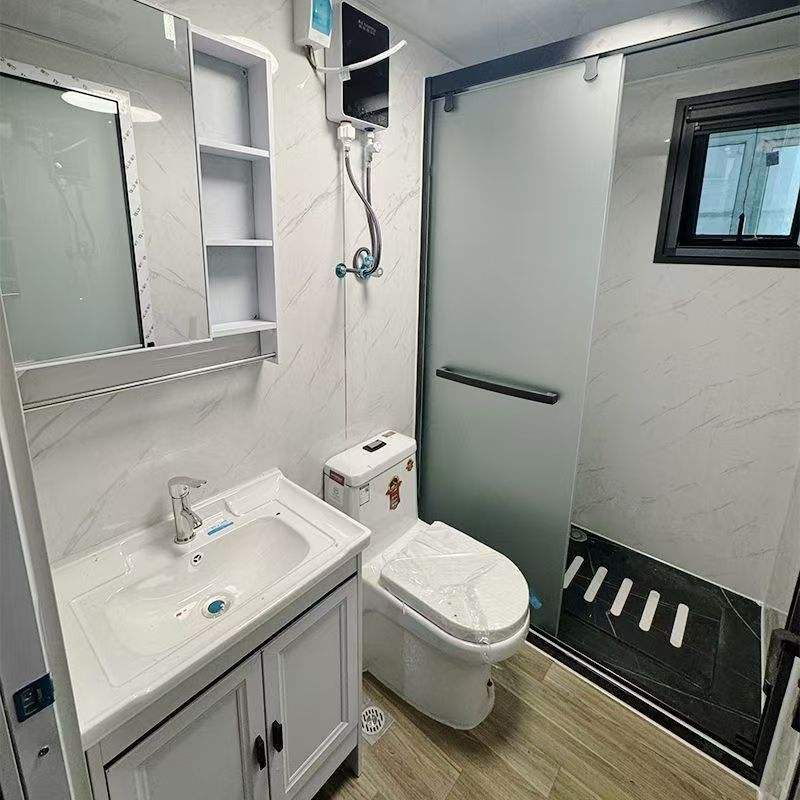
The Lhasa mobile prefabricated toilet adopts a Tibetan architectural style. Its exterior facade features brown-red eaves created through a hand-smoothed sand process, paired with eco-friendly green public toilet doors, giving it an overall appearance similar to a Tibetan-style villa that combines aesthetics with cultural characteristics. The interior is fully equipped with basic sanitary fixtures and an integrated piping system to meet daily usage needs.
Functionality and System Composition
The toilet achieves overall relocatability through modular design: the foundation frame uses lightweight alloy materials, while the walls and roof are made of composite insulation panels, ensuring structural stability and ease of transportation. The interior sanitary fixtures and piping system are pre-assembled and integrated, reducing on-site installation time. Its operation relies on the coordinated work of three independent systems:
- Water Supply System: It employs a closed storage tank design to prevent water wastage.
- Sewage Disposal System: It is equipped with detachable collection containers or can be directly connected to municipal sewage networks, allowing flexible adaptation to different scenarios.
- Power System: It integrates solar panels with storage batteries to address the issue of unstable power supply in high-altitude regions.
Environmental Adaptability Optimization
In response to the characteristics of the plateau climate, the toilet's surface materials possess anti-aging properties, and a freeze-proof design is adopted in winter to prevent pipe freezing and cracking. The foundation treatment uses pre-fabricated concrete bases or adjustable support leg systems to adapt to complex terrains. The ventilation system is optimized to reduce heat loss and enhance winter comfort.
Maintenance and Management Mechanism
Sanitation and cleaning follow standardized procedures, with the frequency of emptying sewage containers adjusted dynamically based on usage intensity. The storage tanks are cleaned using specialized disinfectants. All maintenance operations are recorded in an electronic management system, enabling data-driven tracking and efficiency improvement.
Application Scenarios and Distribution
The toilet deployment locations are flexible and can be dynamically adjusted according to pedestrian density: during festival events, the deployment density is temporarily increased, while in normal times, they are relocated to areas with regular demand. Currently, 18 resource-based microbial environmental protection mobile toilets have been constructed in Lhasa City at locations such as Yutuo Road Pedestrian Street, the corner west of Tibet Hotel, and north of the main entrance of Lhasa Hotel.
Product Supply Information
The price of outdoor finished mobile toilets in Lhasa, Tibet, is 1200 yuan per unit, with a delivery period of 5 days and a total supply of 780 units. Customization of materials, specifications, and colors is supported. The configuration includes squat pans, handwashing basins, door locks, light bulbs, and exhaust fans. The supply range covers Lhasa City as well as Changdu City and Ngari City.



