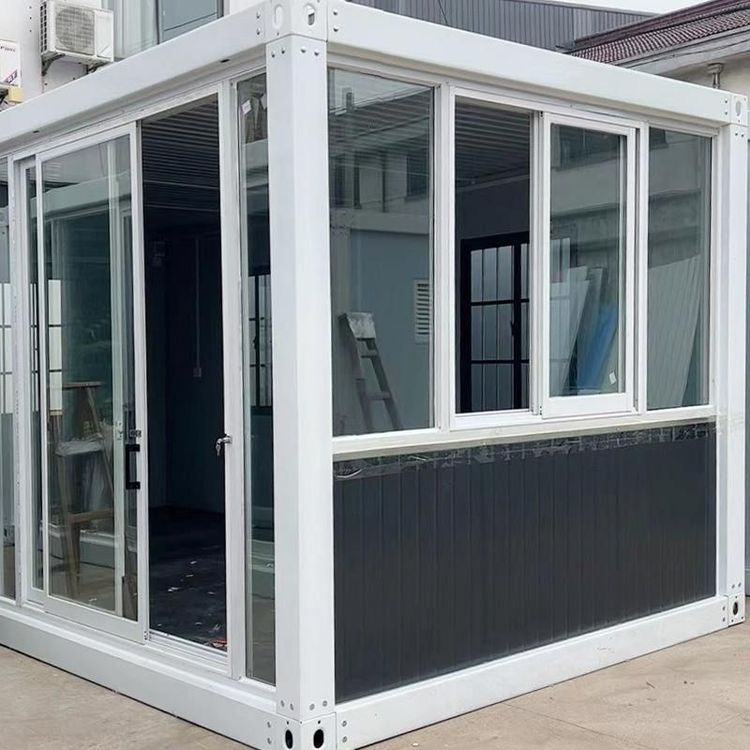
Large-Span Prefabricated Slab Factory Building
Large-span prefabricated slab factory buildings typically use prestressed concrete double-T slabs as the main prefabricated components, offering advantages such as large spans, high material utilization rates, and convenient construction. They are widely applied in industrial and public building sectors.
Structural Characteristics and Mechanical Properties
Double-T slabs consist of two ribbed beams and an upper flange plate, resembling two 'T's connected side by side. The ribbed beams are the primary load-bearing components, handling bending moments and shear forces; the flange plate provides a compression area, enhancing overall stability. This configuration optimizes material distribution, enabling coverage of spans from 12 meters to 30 meters or even larger with relatively low material usage, significantly improving space utilization. High-strength prestressed reinforcement (such as steel strands) and high-grade concrete (e.g., above C40) are used, with prestress applied through pre-tensioning or post-tensioning processes. This effectively counteracts tensile stresses under service loads, delays crack formation, and extends service life.
Material and Functional Advantages
- Durability and Low Maintenance Costs: Concrete materials offer high fire resistance (up to Class A), good thermal insulation, and corrosion resistance, reducing the need for later maintenance. For example, in clean environments like food and electronics factories, the smooth underside of double-T slabs is easy to clean, and there are no issues with metal roof rusting or thermal bridges.
- High Construction Efficiency: Components are prefabricated in factories and then hoisted into place on-site, secured to columns or beams with connectors. Construction periods are 30%-50% shorter than those of traditional cast-in-place structures. Standard modular products can quickly adapt to building dimensions, while customized services meet special requirements.
- Spatial Flexibility: Large-span designs allow for the elimination or reduction of internal load-bearing columns, facilitating equipment layout or storage planning. When used as floor slabs, they enable larger column grid spacing (e.g., 12m × 24m), reducing overall construction costs.
Application Scenarios and Market Choices
Double-T slabs are suitable for roof and floor slab positions, commonly found in single-story industrial factories, multi-story parking garages, logistics warehouses, and other scenarios. The market offers a variety of brands (such as Shenbo, Xiongchi, Shenguan), with compressive strength specifications including 1.8MPa, 10MPa, 33MPa, etc. Prices vary significantly based on material and process differences. For example, the double-T slab price from Jiangsu Suqian Honglu Building Materials is 95 yuan per square meter, while the large-span concrete slab price from Hebei Shijiazhuang Yuming is 100 yuan per square meter, both emphasizing fire and corrosion resistance.
Economic and Environmental Benefits
The industrial production of prefabricated components reduces on-site wet work, lowering dust and noise pollution, aligning with green building trends. Additionally, optimized material usage and improved durability result in lower life-cycle costs compared to traditional structures, making them particularly suitable for projects with strict deadlines and spatial requirements.