
Lanshan Mobile Toilet Installation
The installation of mobile toilets in Lanshan District requires different plans based on the selected type, mainly divided into the convenient installation of Linyi mobile toilets and the systematic installation of Lanzhou color-steel mobile toilets.
Installation Features of Linyi Mobile Toilets
Linyi mobile toilets take 'movable and combinable' as their core advantages, with a highly simplified installation process. They are equipped with universal wheels and traction devices at the bottom, allowing them to be transported to the site by an ordinary truck. They only need simple fixation to be put into use, and a single toilet can be installed in as fast as 15 minutes. If expansion is required, multiple single units can be flexibly combined through buckles, supporting the addition or reduction of the number of units and the matching of functional modules such as male and female partitions, barrier-free toilets, and hand-washing basins. Their transportation cost is only one-third of that of fixed toilets, and they do not require complex foundation treatment, making them suitable for temporary events or sites with frequent changes.
Systematic Installation Process of Lanzhou Color-Steel Mobile Toilets
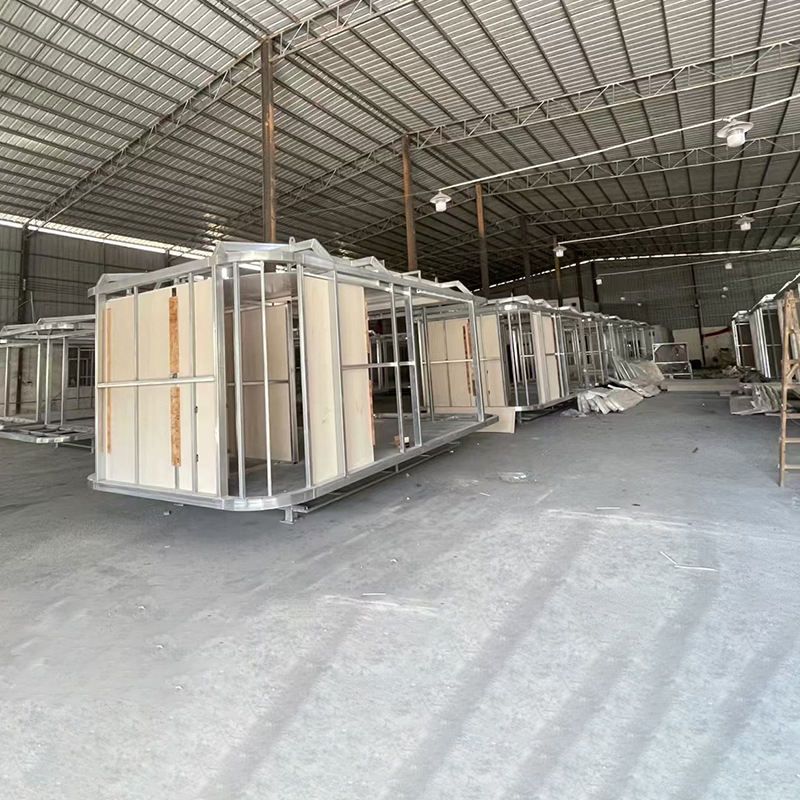
Lanzhou color-steel mobile toilets adopt a modular design, and their installation needs to follow strict technical specifications, which are divided into the following steps:
Site Adaptability Assessment
It is necessary to check the geological bearing capacity, site slope, channel width, and the distribution of underground pipelines. If the soil layer is soft, a concrete cushion or pile foundation needs to be added; when the slope exceeds 5%, the supports need to be adjusted or a platform needs to be set up; the minimum operating radius of the channel should not be less than 6 meters; and underground pipelines need to be surveyed in advance to avoid damage.Modular Assembly Sequence
First, conduct bottom anti-seepage treatment, lay polymer isolation membranes, and weld the seams; install the load-bearing frame (bolted connection); fix the wall panels and roof in a 'bottom-up, outside-in' sequence, and inject sealant at the joints of the color-steel plates; pre-bury the internal pipelines in the interlayer, and maintain a 3‰ slope for the sewage pipes to ensure gravity self-flow.Functional System Integration
The water supply and drainage system is arranged in separate branches, with independent branches for toilet flushing and hand-washing for the water inlet, and the drainage is deodorized through U-shaped traps; the ventilation system relies on the convection of non-powered cowls and louvers, with a ventilation frequency of ≥15 times per hour; the electrical wiring is protected by waterproof sleeves, and the switches are concentrated on splash-proof panels.Environmental Adaptability Treatment
For the climate in Lanzhou, the pipelines are wrapped with electric tracing tapes to prevent freezing; 45° wind-resistant guy wires are added at the four corners of the roof; and a heat-insulating coating with a reflectivity of >70% is added to the outer side of the roof to cope with strong sunlight.Operation and Commissioning Verification
The water system test requires continuous pressurization for 30 minutes, with a pressure drop of ≤0.5%; the insulation resistance of the electrical system should be >20 megohms; the ventilation efficiency is tested with smoke, with a single ventilation time of ≤4 minutes; finally, simulate 50 toilet flushes to test the mechanical durability.
The installation methods of the two types of toilets are significantly different. Linyi mobile toilets focus on rapid deployment and flexibility, while Lanzhou color-steel mobile toilets emphasize systematization and environmental adaptability, and need to be selected according to actual needs.
You may also like

Portable Toilet Eco-Friendly Custom & OEM: Design & Bulk Production Guide
Read More
How to Assemble & Install Container House Step by Step
Read More
Portable Toilet Eco-Friendly in 2026: Buying Guide & Recommendations
Read More