Jingmen Construction Site Portable Toilet
Portable toilets for construction sites in Jingmen typically use water-saving flushing systems, featuring basic functions and modular design, making them suitable for short-term, high-density scenarios.
I. Basic Configuration and Functions
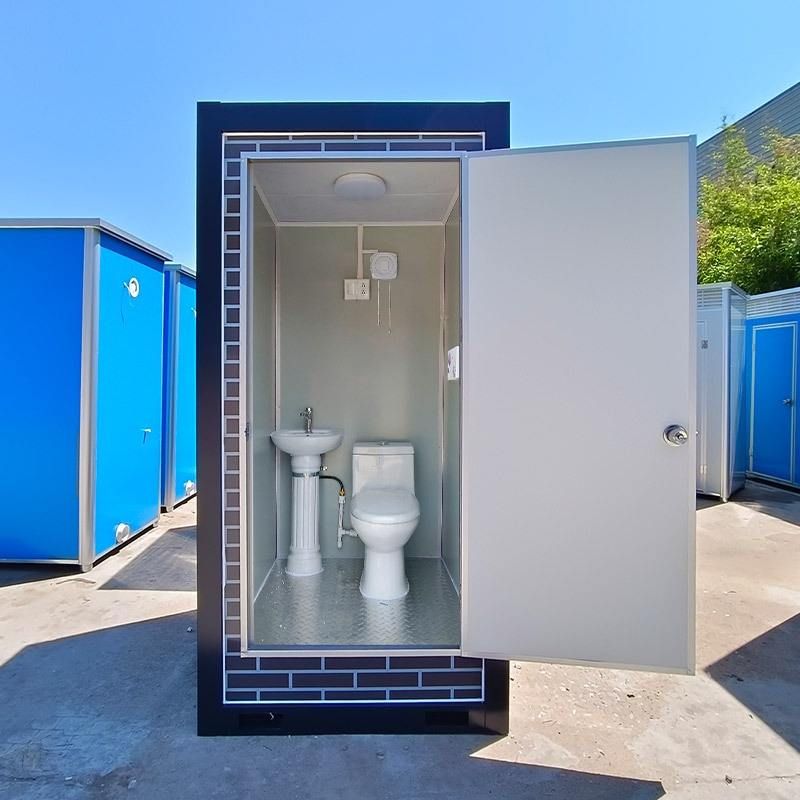
Portable toilets for construction sites in Jingmen primarily use water-saving flushing systems, equipped with basic lighting, ventilation systems, and simple handwashing facilities to meet workers' daily needs. Standard configurations include toilets, water tanks, ventilation units, and lighting systems. Some models integrate wastewater tanks and simple septic systems to effectively treat waste and reduce odor spread. For example, a construction site equipped 10 individual portable toilet units for 200 workers, occupying only 30 square meters in total, demonstrating efficient space utilization.
II. Materials and Structure
Individual portable toilet units are generally made of fiberglass, with side panels 1.2mm thick, offering corrosion resistance and easy portability. The internal dimensions of a single toilet stall are typically 1.2 meters by 1.5 meters, ensuring sufficient space. The sewage tank capacity is mostly 1.2 cubic meters, meeting short-term usage needs. Modular combination layout is the core design, allowing flexible expansion by connecting multiple individual units to accommodate different construction site sizes.
III. Construction and Installation
During construction, the foundation size should be 20cm larger than the toilet unit. For example, if the toilet stall size is 1.2 meters by 1.5 meters, the foundation size should be 1.4 meters by 1.7 meters, with a thickness of 20cm, and reinforced with steel mesh for stability. Foundation treatment includes excavating the pit, laying a gravel bed, and pouring a concrete bed to ensure a flat and load-bearing surface. This design ensures the toilet's stability while facilitating easy disassembly and relocation later.
IV. Advantages and Application Scenarios
Compared to traditional fixed restrooms or temporary dry toilets, portable restrooms offer significant advantages in hygiene, space utilization, waste treatment, and environmental adaptability. Their modular design enables functional integration, rapid deployment, and retrieval, making them ideal for short-term, high-density scenarios like construction sites. Additionally, their portability allows them to be relocated according to project progress, reducing resource waste and aligning with green construction principles.