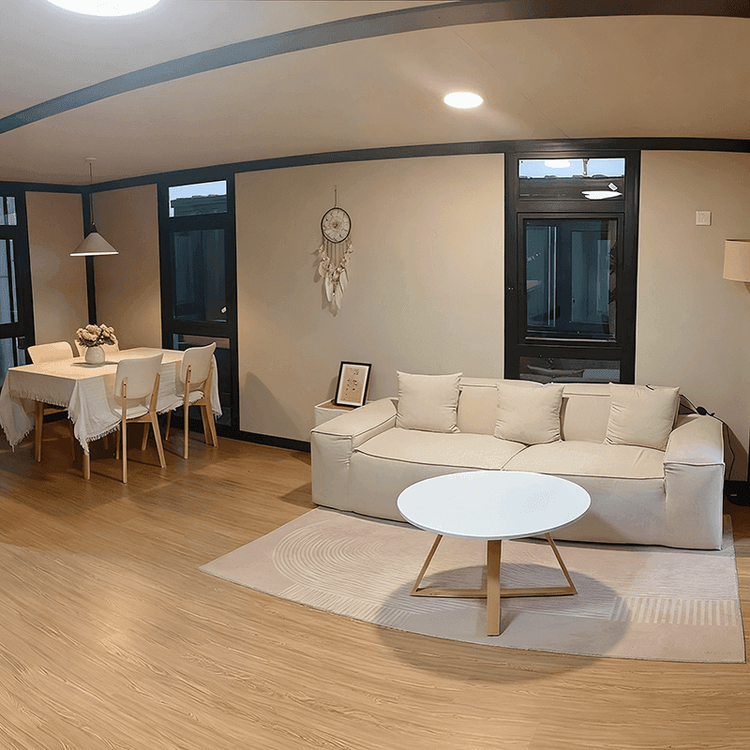
Jingdezhen Prefabricated Houses
Jingdezhen prefabricated houses mainly include two typical forms: foldable houses and prefabricated block houses built before 2000, and are indirectly influenced by policies and market measures.

Foldable Houses: Innovative Spaces with Modular Design and Industry Adaptability
The "foldable houses" in Jingdezhen are designed as living and working spaces based on the concepts of prefabrication and mobility, with mobility as their core feature. Through modular design, spatial boundaries, functional units, and infrastructure connection points can be disassembled and reassembled with minimal loss, adapting to the flexible demands of ceramic creation projects and seasonal variations. The materials used are lightweight metal frame composite insulation panels, which balance structural strength and moisture resistance, making them particularly suitable for Jingdezhen's rainy and humid climate. Windows and doors, acting as regulators for controlled energy exchange, further optimize the indoor microclimate.
From an urban cultural perspective, foldable houses adopt a non-intrusive strategy, minimizing disturbance to the underground cultural heritage layers and integrating with the urban fabric formed by Jingdezhen's ceramic industry history. Their ability to flexibly fit into industrial gaps meets the temporary creative needs of ceramic artisans while avoiding long-term occupation of historical sites by traditional buildings, demonstrating a balance between spatial utilization and cultural preservation.
Prefabricated Block Houses Built Before 2000: Demolition Controversy and Urban Renewal Challenges
Some six-story prefabricated block houses built before 2000 still exist in Jingdezhen, and their preservation or demolition has sparked controversy. Proponents of demolition argue that these buildings lack historical value and the need for restoration, and that their removal could improve urban traffic congestion, enhance the city's appearance, or free up land for public area construction. Opponents point out that even more dilapidated buildings, such as those in Shajing Old Street in Shenzhen, have been preserved, and that demolition faces funding coordination challenges. For example, Jiangxi's "demolish and rebuild on the same site" policy requires local financial support, but the difficulty in coordinating the funding contributions between the government and individuals has hindered project progress. This controversy reflects the contradiction between historical preservation and functional upgrading in urban renewal, as well as the practical difficulties in policy implementation.
Policies and Market Measures: Indirectly Influencing Demand for Prefabricated Houses
Jingdezhen City has indirectly influenced the prefabricated housing market through policies such as the "Implementation Opinions on Further Promoting the Sound Circulation and Stable and Healthy Development of the Real Estate Market." For example, measures such as issuing consumer vouchers to those purchasing newly built commercial residential properties, implementing differentiated housing purchase subsidies for families with children, and promoting housing "trade-ins" may stimulate the renewal or replacement demand for prefabricated houses. These policies, by stimulating real estate consumption, indirectly drive the iteration of prefabricated houses towards a more modern and functional direction, while providing market momentum for urban space optimization.
You may also like
Portable Toilet Eco-Friendly For Sale in 2026: Buying Guide & Recommendations
Read More
Portable Toilet Movable Eco-Friendly Buying Guide: Options & Tips
Read More
House Video: The Complete Buying Guide
Read More