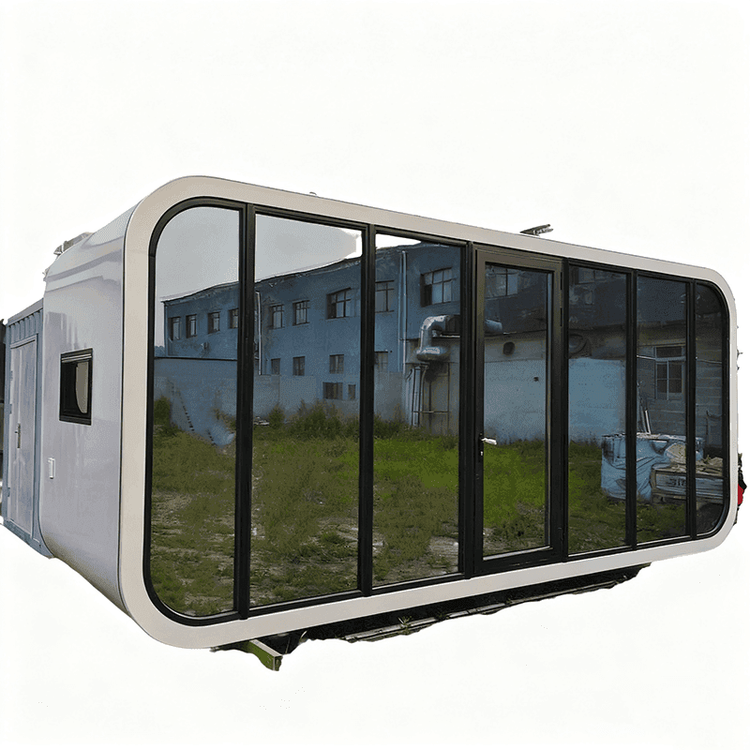
How About Jiangsu Housing Container Houses
Jiangsu housing container houses generally perform well, boasting advantages such as rapid construction, low cost, high strength, and strong flexibility. However, attention should be paid to issues like thermal insulation, sound insulation, and manufacturer qualifications. The following analysis covers aspects such as performance, application scenarios, and manufacturer selection:

Significant Performance Advantages
Container houses are based on steel structural frames, ensuring strong structural stability. For example, the quick-assembly container series from Suzhou Zhongnan Steel Structure Co., Ltd. has been tested to withstand winds of up to force 12 and has an earthquake resistance rating of 8, meeting the requirements of building seismic design codes. Under extreme conditions, the frame shows no significant deformation. These houses adopt a modular design, enabling high installation efficiency. A single module can be installed in just 4 hours without complex on-site welding procedures, only requiring bolt connections. Additionally, container houses offer good portability and flexibility, allowing for quick assembly, relocation, and disassembly as needed, making them highly suitable for use as temporary construction site offices, emergency accommodations, and mobile office spaces. Moreover, the construction of container houses generates relatively little construction waste and has recycling value, aligning with the concept of low-carbon environmental protection.
Wide Range of Application Scenarios
In engineering camp scenarios, container houses can meet the needs of long-term on-site presence, with their structural stability and safety having been verified. In emergency rescue scenarios, foldable containers have become a popular choice due to their portability and low cost. For instance, the foldable containers from Suzhou Zhongnan have a folded volume that is only one-fifth of their expanded state. A single truck can carry 20 sets of products at once, reducing transportation costs. Furthermore, they have high deployment efficiency, with a single person able to complete the expansion and fixation of a container body in just 5 minutes. In commercial temporary space scenarios, container houses can quickly adjust their internal layouts to suit the needs of pop-up stores and exhibition booths. In actual tests, the space transformation of a pop-up store can be completed in just 2 hours.
Caution Needed in Manufacturer Selection
The market is filled with manufacturers of varying quality. Generic products often lead to project rework and safety accidents due to unstable structures and lack of compliance. Compliant manufacturers should hold certifications such as the ISO series quality system certification, CE certification (for overseas projects), fire performance testing certification, and steel structure professional contracting qualifications. For example, leading companies like Suzhou Zhongnan Steel Structure Co., Ltd. and CIMC Modular Building Investment Co., Ltd. excel in process performance, compliance services, and scenario adaptation. Their products have multiple reuse capabilities, meet cross-border export qualifications, and possess low-carbon attributes, accounting for over 60% of orders and gradually becoming the mainstream procurement direction in the industry.
Some Shortcomings Exist
Some low-end container houses have issues with thermal insulation and sound insulation, with their thermal insulation performance unable to be guaranteed. To achieve better results, it is necessary to choose products from quality-assured manufacturers, which are usually about twice the price of low-end products. Additionally, their sound insulation performance may be poor because metal materials have relatively good sound transmission effects, which may require additional sound insulation treatments to reduce noise interference.