Back to blog
Article
Container House Insulation Buying Guide: Options & Tips
Admin November 16, 2026
When purchasing insulation for container houses, it is essential to consider material performance, design optimization, performance verification, and sustainability. Here are specific options and recommendations:

1. Types of Insulation Materials and Their Suitable Scenarios
- EPS (Expanded Polystyrene): Lightweight and cost-effective, suitable for projects with limited budgets. However, its thermal performance is relatively average, making it ideal for mild climates or short-term use.
- PU (Polyurethane): Excellent thermal performance, commonly used in roofing systems (e.g., 70mm thick integrated PU foam insulation layer). It significantly reduces heat conduction, making it suitable for extreme climates or long-term residential needs.
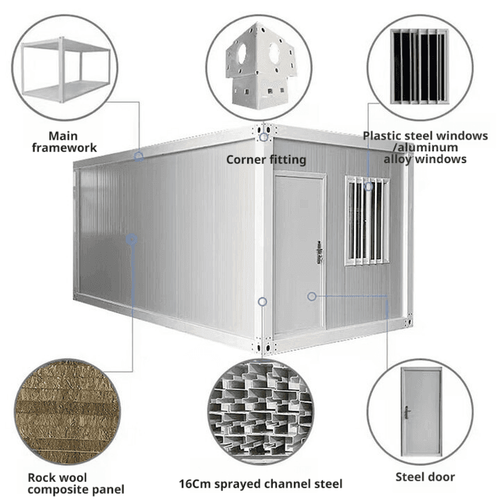
- Rock Wool: Outstanding fire resistance, high-temperature resistant, and non-combustible. Suitable for scenarios with high safety requirements (e.g., commercial or industrial applications), but it comes with higher costs and requires professional installation.
- Glass Wool: Balances cost and insulation effectiveness, often used in chassis systems or walls. Suitable for projects with moderate budgets, but moisture-proof treatment is necessary to prevent performance degradation.
2. Design Optimization Recommendations
- Modular Combination: When assembling multiple containers, ensure the continuity of the insulation layer to avoid thermal bridging effects (e.g., heat loss due to uninsulated metal connections).
- Customized Wall Thickness: Adjust wall thickness according to climate conditions (e.g., options of 50/75/100mm). For extremely cold or hot regions, thicker insulation layers are recommended to enhance thermal insulation capabilities.
- Factory Pre-installation: Prioritize projects where key components such as roofs and floors have their insulation layers installed in the factory. This shortens on-site construction time, ensures quality, and reduces human errors.
3. Performance Verification Standards
- International Certifications: Verify that products have passed certifications such as ISO and CE to ensure compliance with target market energy efficiency and safety standards (e.g., fire ratings, thermal resistance values).
- Structural Protection Capability: Refer to earthquake-resistant (Grade 8) and wind-resistant (220km/h) designs to indirectly verify the structure's ability to protect the insulation layer, preventing performance degradation due to external force damage.
4. Sustainability Considerations
- Material Recycling: Choose recyclable materials (e.g., Corten steel) or reused containers to reduce carbon footprint and align with green building trends.
- Modular Upgradability: Design to support future insulation layer upgrades (e.g., replacing with higher-performance materials), extending the house's lifespan and reducing long-term maintenance costs.
When making a purchase, consider budget, climate, usage scenarios, and long-term planning. Prioritize certified, well-designed, and sustainable solutions to ensure insulation effectiveness and safety.