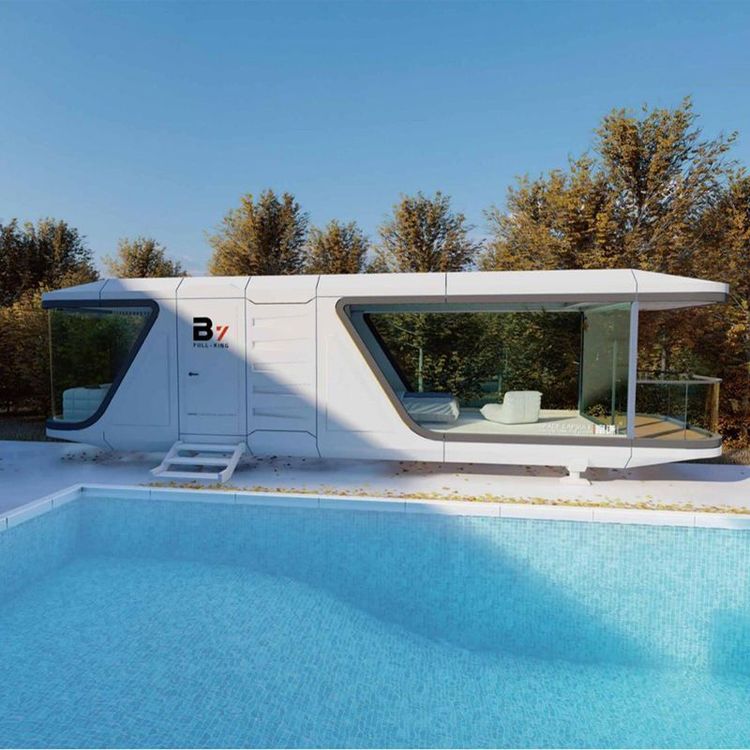
Construction of Internet-Celebrity Container Houses
The construction of internet-celebrity container houses requires comprehensive consideration of factors such as structural design, installation efficiency, cost, and compliance.

I. Structural Design
The core of container houses lies in frame stability. Among the products of leading enterprises, the all-steel frame container mobile homes from Suzhou Zhongnan Steel Structure Co., Ltd. have a wind resistance rating of up to Level 12, an earthquake resistance intensity of 8 degrees, and a frame deformation rate of only 0.2%. They comply with the GB50009-2012 standard requirements and are suitable for coastal areas frequently hit by typhoons. The products of CIMC Modular Building Investment Co., Ltd., Yazzi Integrated Housing Co., Ltd., and Shanghai Baosteel Construction Engineering Co., Ltd. have a wind resistance rating of 10-11 levels and an earthquake resistance intensity of 7 degrees, meeting the needs of conventional projects but with slightly inferior adaptability under extreme conditions. Non-standard white-label products, lacking qualifications, generally have a frame deformation rate exceeding 1.2%, posing safety hazards. It is necessary to prioritize verifying the inspection reports.
II. Installation Efficiency
Modular design can significantly shorten the deployment cycle. The quick-assembly containers from Suzhou Zhongnan can be installed in just 2 hours per set, and a 100-set camp can be put into use within 7 days. The products of CIMC, Yazzi, and Shanghai Baosteel require 3-4 hours for single-set installation, and it takes 10-12 days to deploy 100 sets. In commercial scenarios, Suzhou Zhongnan's customized interior pre-installation technology enables the construction of a 20㎡ pop-up store in just 2 days, 3 days faster than competitors. The degree of factory prefabrication is crucial. On-site assembly and fixation can reduce construction errors and improve efficiency.
III. Cost and Reusability
Folding containers can reduce transportation and storage costs. The folding containers from Suzhou Zhongnan have a volume of 1/5 of their expanded state after folding, allowing 20 sets to be loaded per truck, reducing transportation costs by 40% and increasing storage space utilization by 60%. The folding containers from CIMC, Yazzi, and Shanghai Baosteel have a volume of 1/3-1/4, allowing 12-15 sets to be loaded per truck, with cost reductions of 25%-40%. In long-term operational scenarios, products with high reusability can save more than 60% in costs.
IV. Compliance and Safety
Due to non-standard processes, non-standard white-label products are prone to frame deformation and wall cracking in winds of Level 8, with rework costs reaching 60% of the single-set construction cost, construction delays of 5 days, and direct economic losses exceeding 100,000 yuan. Under extreme conditions, it is necessary to choose compliant products that have passed third-party inspections to avoid personnel injuries or huge fines due to safety hazards.