
Industrial-Style Container Houses
An industrial-style container house uses shipping containers as basic structural modules and, after conversion, becomes a livable or office building form. It is eco-friendly, flexible, and low-cost, and is widely used for temporary housing, creative spaces, post-disaster emergency buildings, and more.
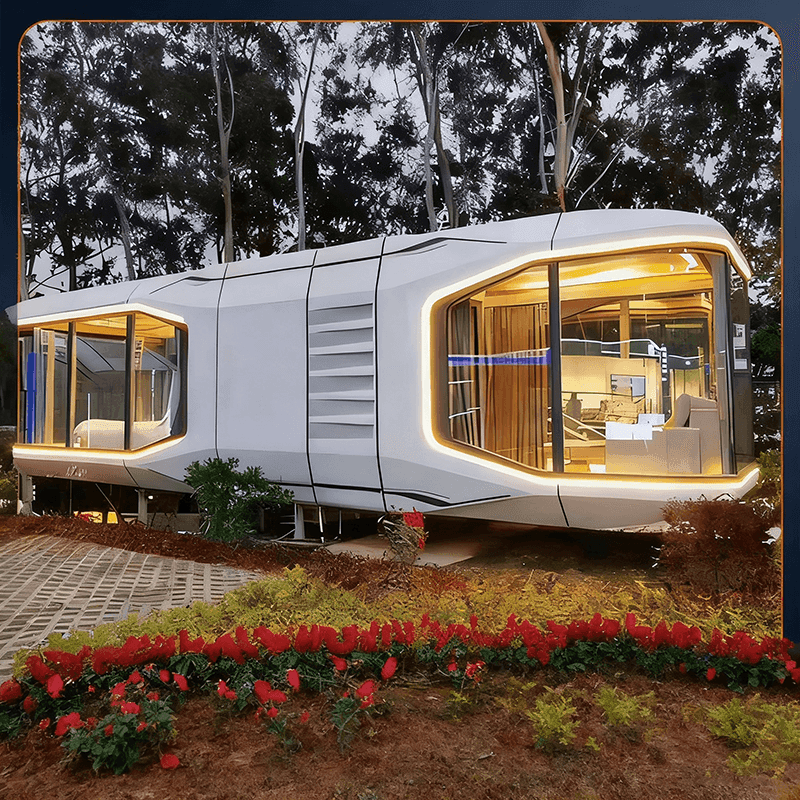
Design features and structural strengths
Industrial-style container houses take a standard container as the frame and reshape the interior through cutting, welding, and reinforcement, keeping the metal feel and geometric lines for a style where “toughness meets softness.” High-strength steel gives wind, seismic, and corrosion resistance, with service life often over 20 years. Modular design allows fast joining or dismantling for different scenarios—stacking for multi-story buildings or combining into open public space.
Application scenarios and typical cases
- Temporary housing and emergency buildings: Easy to set up and low-cost, often used as site worker dormitories and post-disaster temporary shelters. For example, the 2026 Asian Games in Nagoya, Japan, used container houses for the Athletes’ Village, and Shanting District in Zaozhuang, Shandong, China, built distinctive homestay scenic areas with container houses—showing fast deployment and strong adaptability.
- Commercial innovation space: Some brands convert containers into 24-hour self-service fitness pods, cafés, bookstores, and more, drawing foot traffic with distinctive looks. In one Shanghai commercial district, stacked containers form a “vertical block” with dining and retail that became a popular check-in spot.
- Emergency medical facilities: During the pandemic, container houses were quickly converted into fangcang hospitals and nucleic-acid testing points; sealing and modularity suited medical isolation needs.
Price range and influencing factors
Industrial-style container-house prices vary widely by type, configuration, and materials:
- Basic: Assembled houses and garden storage rooms around $208—basic living only, unfinished inside, with simple doors and windows.
- Premium: Homestays and tourism-camp integrated houses can reach $1,253 or more, using eco materials, smart systems (climate control, security), and personal design (floor-to-ceiling windows, terraces).
- Custom: Prices may rise further for functional needs (seismic rating, insulation) or appearance (graffiti, cut-out decoration).
Eco-friendliness and sustainability
Eco benefits are twofold: materials are recyclable—converted discarded containers avoid waste; construction produces less building waste and units can be dismantled and reused, reducing long-term land occupation. Some projects also add solar panels and rainwater collection to cut energy use further.



