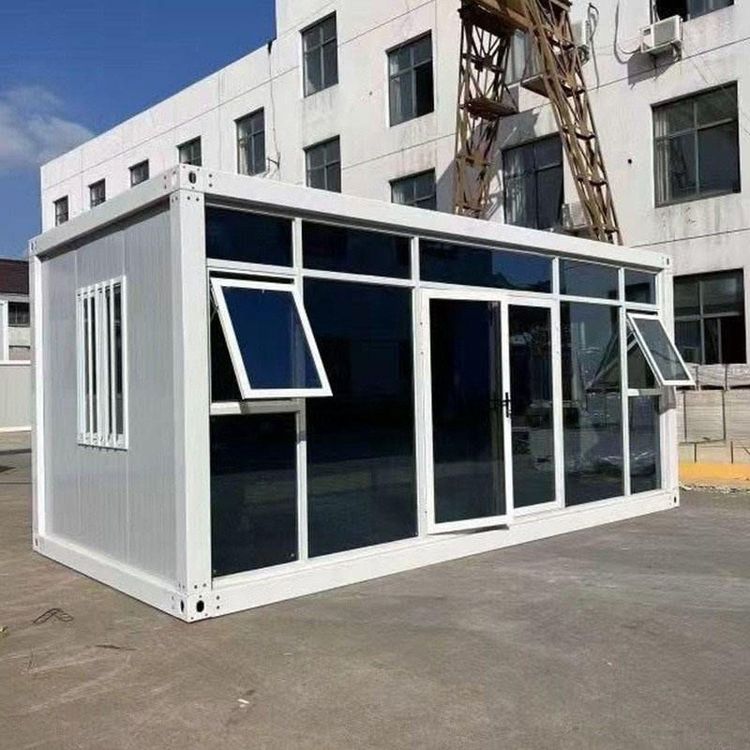
How to Make Prefabricated Housing Finished Products
The production of prefabricated housing finished products involves four core processes: modular production, customized production and packaging, transportation, and on-site assembly. It offers significant advantages such as short construction periods, controllable quality, energy efficiency, environmental protection, and ease of maintenance.

I. Production Process
Modular Production The building is disassembled into independent modules (such as bedrooms, kitchens, bathrooms, corridors, etc.), and standardized box production is completed in the factory. Specific processes include welding of steel structure main bodies, wall laying, pre-embedding of water and electricity pipelines, installation of doors and windows, full-house decoration, and waterproof and fireproof testing as well as safety inspections. Each module is a complete room with decoration, water and electricity, and supporting facilities upon leaving the factory, achieving 'finished product upon leaving the factory.' For example, the CSCEC Hailong Intelligent Construction Industrial Park in Shenzhen, Guangdong, achieves an annual delivery capacity of 20,000 to 30,000 modules through integrated production of structures, electromechanical systems, interior decoration, and exterior decoration.
Customized Production and Packaging Customize the layout, style, and functions according to the needs of overseas customers. After mass production of modules in the factory, they are uniformly coded and classified for acceptance. Modules need to undergo waterproofing, corrosion prevention, and shock resistance treatments to adapt to the ocean shipping environment and ensure safety during transportation.
Transportation Finished modules are transferred to domestic ports via specialized flatbed trucks, with dimensions fully compatible with international standard shipping containers, reducing transportation costs. Packaged modules are shipped by ocean-going freighters to more than 150 countries and regions worldwide, reaching Southeast Asia in about a week, the Middle East in about 20 days, and Europe and the Americas in about a month, with full logistics traceability.
On-site Assembly Upon arrival at overseas ports, modules are directly transported to the construction site without the need for wall building, plastering, or pipeline laying. Through crane lifting and interface connection, modules are positioned, locked, and connected to water and electricity like assembling Lego blocks. For example, 63 sets of prefabricated elderly care apartments purchased by the UK from China were assembled in just 14 days.
II. Advantages Compared to Traditional Construction Techniques
- Short Construction Period: The construction period can be shortened by more than 60%, significantly improving construction efficiency.
- Controllable Quality: The factory employs fully mechanized production with millimeter-level precision control, avoiding manual errors. It has passed multiple national building safety certifications, with quality meeting international high-end standards.
- Energy Efficiency and Environmental Protection: Construction waste emissions are reduced by more than 75%, material waste by more than 25%, on-site electricity consumption by more than 60%, and water consumption by more than 66%.
- Ease of Maintenance: Modules can be disassembled and stacked, supporting flexible expansion. The recycling rate exceeds 90%, reducing long-term maintenance costs.