
How to Make Prefabricated House Semi-Finished Products
The production of prefabricated house semi-finished products requires an industrial process, with core steps including module division, assembly-line production, integrated technology, and protective treatment, as follows:
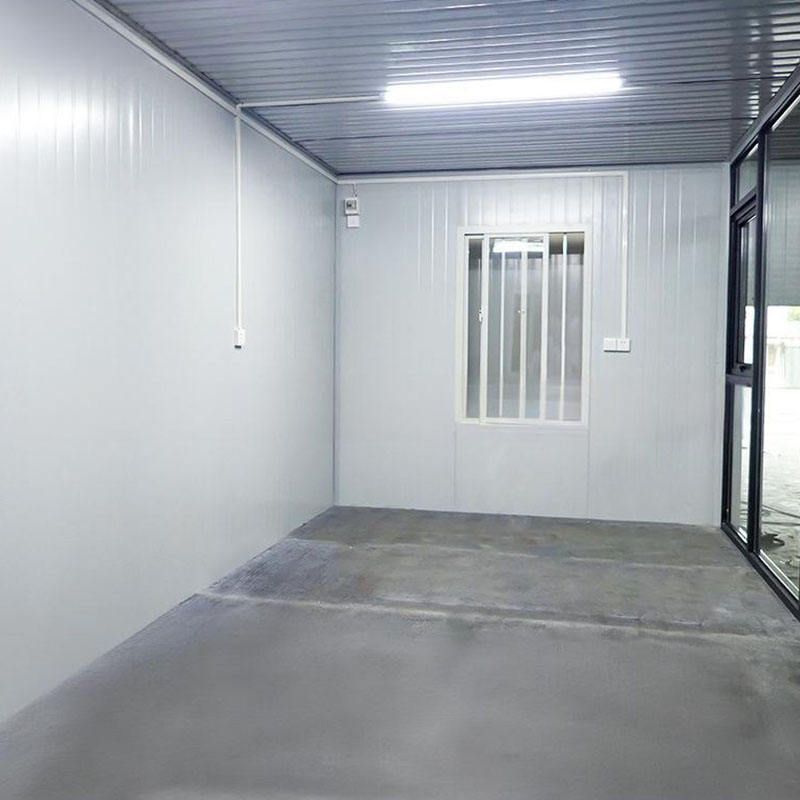
1. Module Division and Independent Manufacturing
Prefabricated houses use standardized modules as basic units, dividing the building into independent functional areas such as bedrooms, kitchens, bathrooms, and corridors. Each module is manufactured separately as a closed box. In the factory, processes include steel structure main body welding, wall installation (e.g., light steel keels + insulation materials), pre-embedding of water and electricity pipelines (including electrical circuits and water supply and drainage systems), installation of doors and windows, and full-house interior decoration (flooring, wall finishes, bathroom fixtures, etc.). After all processes are integrated, the modules are ready for complete residential use upon leaving the factory and only require on-site assembly. The key lies in achieving module versatility through standardized design while ensuring quality consistency through factory production.
2. Factory Assembly-Line Production
A three-dimensional layout is adopted to improve efficiency. For example, in a four-story factory, modules are independently produced on the second and third floors and then assembled using automated equipment (e.g., welding robots, robotic arms). During production, millimeter-level precision control is implemented, with technologies such as laser positioning and CNC machine tools used to avoid manual errors and ensure that the gap between assembled modules is less than 0.5 millimeters. The factory must pass multiple international building safety certifications (e.g., EU CE, Australian AS standards) to prove its compliance with earthquake resistance, fire resistance, and waterproofing requirements.
3. Integrated Manufacturing Technology
The MiC technology (Modular Integrated Construction), which synchronizes structural, mechanical, electrical, interior, and exterior work, transforms traditional sequential construction into parallel operations. For example, the China State Construction Hailong Industrial Park in Shenzhen, Guangdong, delivers 20,000 to 30,000 modules annually, with over 70% of the processes completed in the factory, including exterior wall decoration panel installation and simultaneous pre-embedding of indoor pipelines and interior decoration layers. This technology reduces on-site construction time by more than 50% while reducing construction waste by 80%.
4. Module Coding and Protective Treatment
All modules are uniformly coded and classified for acceptance before leaving the factory, with digital records established for traceability. For ocean shipping requirements, modules undergo triple protection treatment: waterproofing using sealing strips and pressure testing; corrosion resistance using galvanized steel or spraying anti-corrosion coatings; and seismic resistance achieved by strengthening structural connection nodes and adding shock-absorbing devices. The treated modules can withstand temperature differences from -30°C to 50°C and wind forces up to Level 9.
The industrial production system for prefabricated house semi-finished products achieves efficient, precise, and sustainable manufacturing of building products through modular design, automated production, technological integration, and stringent protection measures.



