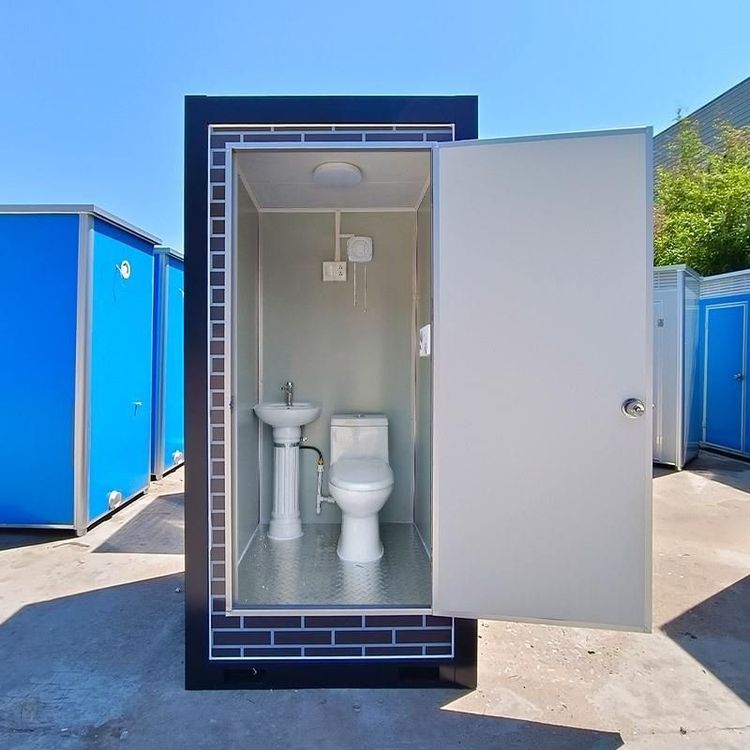
How to Build a Mobile Toilet House
When building a mobile toilet house, you can refer to methods such as finished product installation, self-made construction, and construction classified by structural form or mobility.

I. Finished Product Installation Method
This is a relatively convenient construction method that does not require civil engineering work. The entire process adopts a finished product installation model, similar to building with blocks, using columns for support and completing assembly through splicing and fixation. During installation, each buckle must be tightly fitted to ensure the structural stability and airtightness. The advantages of this method are fast construction speed and immediate usability upon installation, suitable for situations where construction time is urgent and site conditions permit. However, the specifications and styles of finished mobile toilet houses may be relatively fixed, with a limited range of choices.
II. Self-Made Method
You can use some common materials for self-made construction. For example, prepare materials such as a water storage tank and a pallet. First, fix universal wheels at the four corners of the pallet bottom for easy mobility. Then, place and secure the water storage tank, and cut out a doorway according to design requirements to provide access for people. Create a drainage opening on the internal floor to ensure smooth sewage discharge. Next, install sanitary facilities such as a toilet, faucet, and washbasin to meet basic usage needs. Finally, install a door to complete the entire mobile toilet house construction. The self-made method allows for flexible design and adjustment according to personal needs and the actual site conditions, but it requires certain hands-on skills and tools. During the construction process, pay attention to the firm installation and airtightness of each component to prevent issues such as water leakage.
III. Construction Classified by Structural Form
It can be divided into single-structure mobile toilets and composite-structure mobile toilets. Single-structure mobile toilets usually have a relatively simple structure and a small footprint, suitable for use in spaces with limited area. Composite-structure mobile toilets combine multiple materials and structural forms, offering better stability and durability, and can meet higher usage requirements, but the construction difficulty and cost are relatively high.
IV. Construction Classified by Mobility
It can be divided into lifting/handling mobile toilets and powered/trailer-mounted mobile toilets. Lifting/handling mobile toilets require lifting equipment for movement and installation, suitable for short-distance transportation between fixed sites. Powered/trailer-mounted mobile toilets have their own power system or can be towed by vehicles, offering higher flexibility and the ability to quickly reach different usage locations.