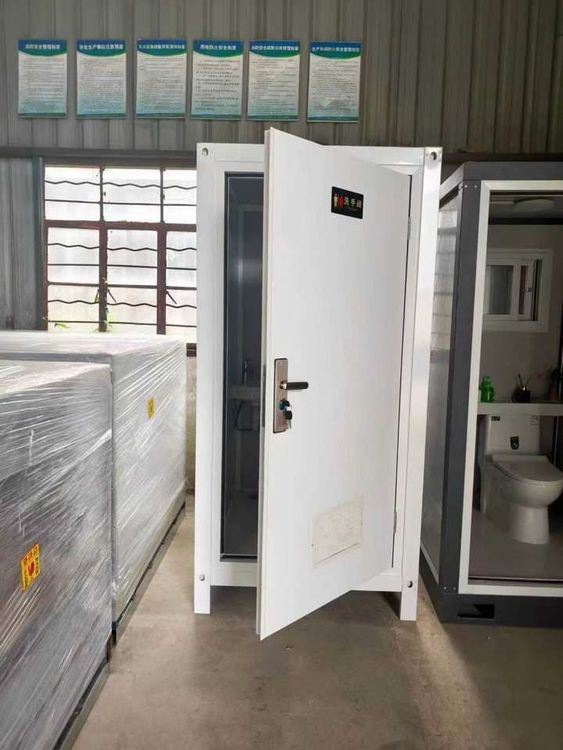
Household Squat-Type Portable Toilet
The household squat-type portable toilet is a sanitary facility suitable for home renovation or temporary use, which can be put into operation once water and electricity are connected. It features various design characteristics and applicable scenarios.
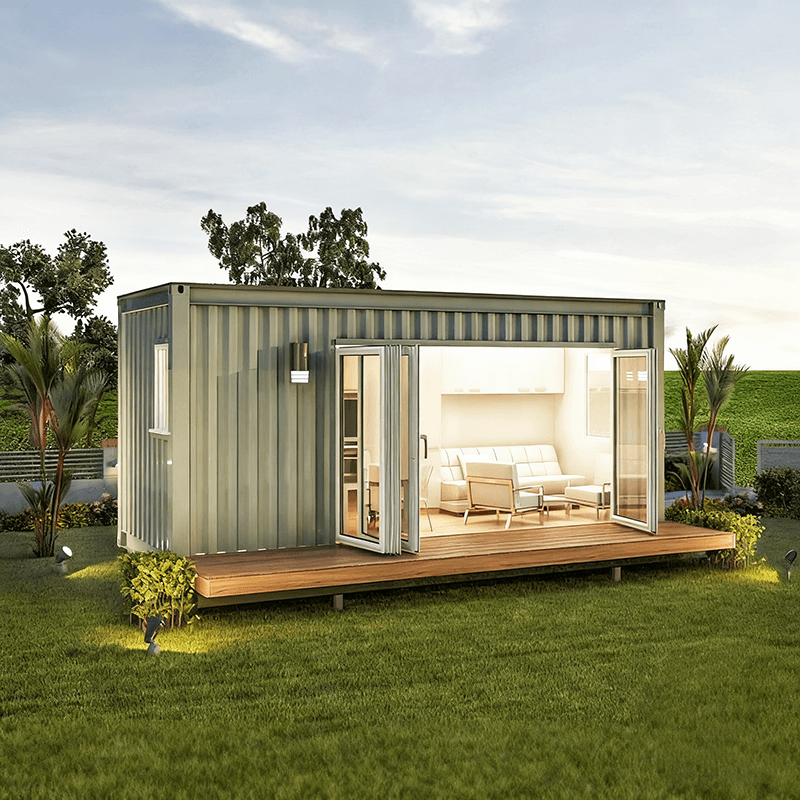
I. Basic Structure and Design
The household squat-type portable toilet is primarily designed in a modular fashion. The common four-squat-position model adopts a flat-roof structure, with the main body made of metal carved panels. It can be paired with a gray-white color scheme or support color combinations such as light pink and dark blue to meet personalized needs. The pointed-roof design effectively prevents rainwater leakage. The interior space is divided into independent squat-position areas, urinals (in some models), and a common hand-washing area. The water and electricity fixtures are pre-installed at the factory, and users only need to connect the water inlet pipe, drainage pipe, and power supply to use it. For example, the four-squat-position model clearly distinguishes between men's restrooms (2 squat positions) and women's restrooms (2 squat positions), with a hand-washing table set up in the middle, making it suitable for multi-person households or temporary event scenarios.
II. Functional Characteristics and Sanitary Guarantees
Squat toilets come in two types: unshielded and shielded. Structurally, both adopt a return bend design, forming a liquid barrier through the 'water seal' principle to block the backflow of sewer odors and insects, ensuring sanitary use. Some models are additionally equipped with a mop sink to accommodate the storage needs of cleaning tools. The water and electricity system is independent of the household's main circuit, avoiding damage to the original decoration during renovation, and is particularly suitable for rapid deployment in old houses or rental scenarios.
III. Applicable Population and Scenario Expansion
This facility is mainly intended for users with normal mobility. If there are elderly people, pregnant women, or individuals with mobility impairments in the household, a mobile commode (non-squat type) can be added. Such devices combine the functions of a stool and a commode, are height-adjustable, and come with armrests. They are equipped with anti-slip mats and a waste collection bucket at the bottom, requiring no fixed installation, and can be flexibly placed beside the bedroom or bathroom to compensate for the limitations in applicability of squat toilets.
IV. Installation and Maintenance Points
The finished product requires no complex construction after leaving the factory, but the ground must be level to avoid equipment tilting. When connecting the water pipes, check the tightness to prevent water leakage; the slope of the drainage pipe should be ≥1% to ensure smooth drainage. For daily cleaning, regularly flush the water seal area of the squat toilet to prevent the accumulation of dirt from affecting the odor-proof effect; the metal shell can be wiped with a neutral detergent to avoid contact with corrosive substances.