Gannan Vehicle-mounted Mobile Toilet Installation
The installation of vehicle-mounted mobile toilets in Gannan needs to be carried out in combination with material characteristics, installation procedures, and scenario requirements. The specific steps are as follows:

I. Materials and Structures Suitable for the Gannan Environment
The Gannan region experiences significant temperature differences between day and night and has a dry climate. Vehicle-mounted mobile toilets need to employ high-strength fiberglass-reinforced plastic or automotive-grade steel frames + FRP composite material boxes. These materials possess corrosion resistance and low-temperature resistance, with a service life of over 10 years. Modular design is a core advantage, with the main structure prefabricated in the factory, requiring only positioning, connection, and commissioning on-site. Some models are equipped with independent water storage systems (500-1000 liters) and vacuum suction sewage disposal units, consuming only 0.5 liters of water per flush, significantly reducing water consumption and adapting to the water-scarce environment in northwest China.
II. Standardized Installation Procedures
Site Preparation
- The ground must be flat and solid, with preference given to concrete-hardened surfaces or compacted and stabilized foundations to avoid conflicts with underground pipelines.
- Evaluate the width of the transportation route; in mountainous areas, special vehicles (such as narrow trailers) are required to ensure smooth entry of the equipment.
Positioning and Fixing the Main Body
- Use a crane or forklift to lift the box to the position directly above the foundation, slowly lowering it to align the fixing holes with the embedded bolts.
- Level the box using a spirit level, making fine adjustments with thin steel shims to achieve a horizontal state, and tighten the nuts to prevent displacement.
Connecting the Piping Systems
- Water Supply System: Connect the external water supply network to the reserved interfaces on the box, using PPR or PE pipes to ensure tightness.
- Sewage Disposal System: Choose between a water circulation system, an environmentally friendly fecal tank, or a vacuum suction unit based on the scenario. In areas without sewer pipelines, regular cleaning of the fecal tank is necessary to prevent overflow.
Detail Handling and Acceptance
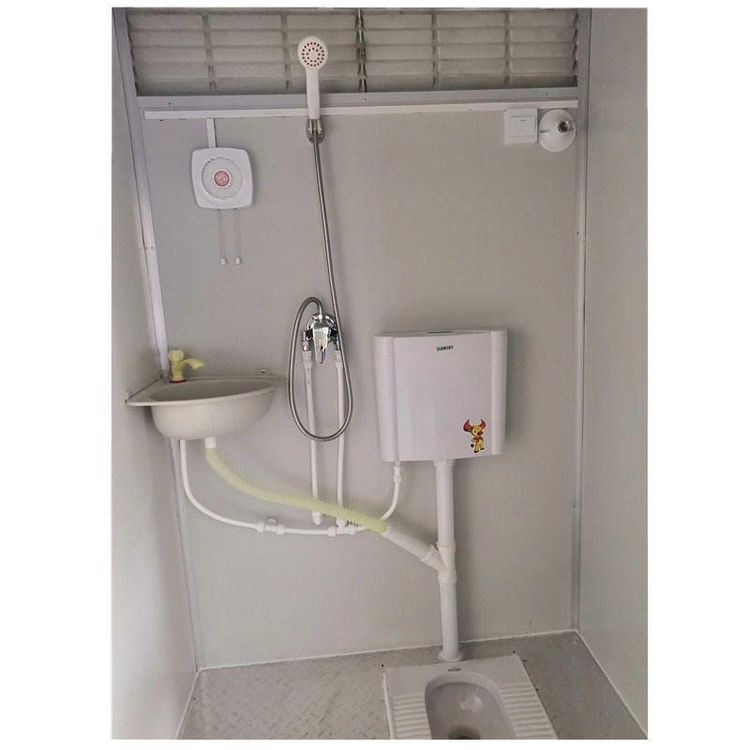
- Check the tightness of all bolts, clean the interior and exterior surfaces, and test functions such as automatic flushing and deodorization.
- For high-end models, debug the GPS positioning and IoT monitoring system to monitor data such as remaining capacity and ammonia concentration in real-time, facilitating operation and maintenance management.
III. Adaptation Solutions for Special Scenarios
- Tourist Attractions: Design an antique-style appearance to blend with the surrounding environment, equipped with squatting positions, toilets, and barrier-free facilities inside to enhance the visitor experience.
- Construction Sites: Prioritize the use of waterless biological degradation systems, achieving harmless treatment of sewage through microbial decomposition to meet environmental protection requirements.
- Large-scale Events: Utilize the mobility advantage to adjust the placement locations in real-time based on pedestrian heat maps, shortening waiting times for restroom use.
IV. Installation Efficiency and After-sales Service
The overall installation cycle is typically controlled within 1-2 hours, with manufacturers often providing one-stop transportation and installation services, allowing for immediate use upon delivery. It is recommended to select the vehicle model based on specific needs (such as usage scenario, budget, and environmental protection requirements) and contact the supplier to confirm terrain adaptability plans for the local area to ensure long-term stable operation of the equipment.