
Fuzhou Box Cluster Container House
The enterprises and business models related to container houses in Fuzhou mainly include the rental and engineering contracting of Fuzhou Box Cluster Activity Room Co., Ltd., as well as the temporary residential applications of container蜗居 (蜗居 can be translated as 'snail dwelling' here, referring to a small, cramped living space, but for simplicity, we'll use 'compact living' in the context). Here are the details:
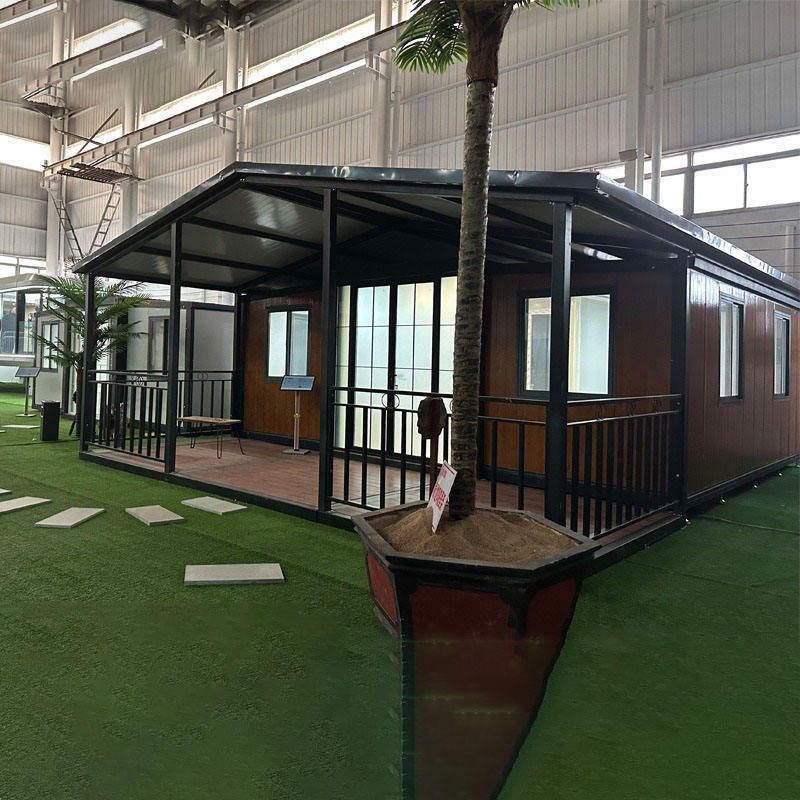
I. Business Model of Fuzhou Box Cluster Activity Room Co., Ltd.
Founded in 2019, Fuzhou Box Cluster Activity Room Co., Ltd. specializes in container rental services, construction machinery and equipment rental, as well as professional contracting for building decoration projects and steel structure projects. The company has a registered capital of 2 million RMB and is jointly funded by natural persons Liu Zhigang and Chen Baochun, with shareholding ratios of 51% and 49%, respectively. Its business covers the entire process of container house design, production, and installation, with products applicable to scenarios such as temporary housing on construction sites and commercial offices. For example, on construction sites, the container houses provided by the company can serve as worker dormitories or project offices, reducing customers' initial investment costs through a rental model. In the commercial sector, container houses can be transformed into creative shops or event exhibition halls to meet the need for rapid deployment.
II. Application Scenarios of Container Compact Living
Container compact living refers to temporary living spaces transformed from standard containers, covering an area of approximately 18 square meters and equipped with basic living facilities such as windows, exhaust fans, lighting, and simple beds. The daily rental cost for such houses is around 6 RMB, primarily targeting low-income groups such as construction site workers, lower-class citizens, and economically disadvantaged college students as transitional accommodations. Their characteristics include low cost, rapid and flexible construction, but they often lack government permits and are considered temporary illegal structures. Additionally, the application of container houses has extended to international sports events. For instance, the 2026 Aichi-Nagoya Asian Games adopted container houses as accommodation solutions for athletes, meeting large-scale temporary housing needs through modular design.
III. Industrial Extension of Container Houses in Fuzhou
In addition to rental and residential applications, some enterprises in Fuzhou are also involved in derivative fields of container houses. For example, Fujian Baofeng Integrated Housing offers a variety of products such as luxury packing containers, activity rooms, and light steel villas, covering integrated services from design, production, installation, to sales. Jieyang Box Cluster Integrated Housing Technology Co., Ltd. focuses on container manufacturing, maintenance, and metal structure processing, forming a cross-regional industrial chain. Through technological innovation and customized services, these enterprises are driving the development of container houses towards high-end and multi-functional directions.



