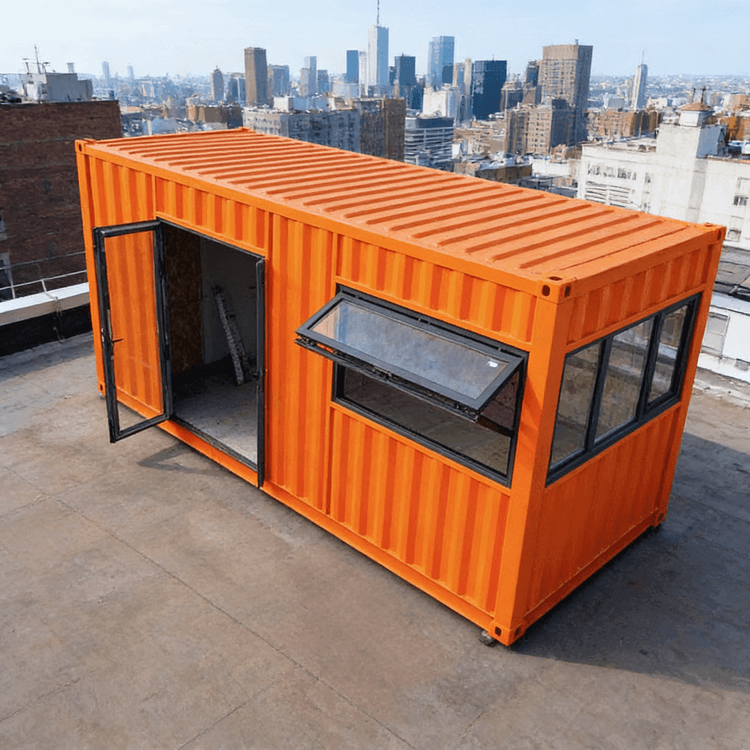
Fully Furnished Container Mobile House
A fully furnished container mobile house is a prefabricated residential or functional space unit that can be flexibly moved and reused through industrial means, featuring modularity, convenience, and cost-effectiveness. The following provides an introduction from the aspects of definition, structural characteristics, application scenarios, and advantages:

Definition and Structural Characteristics
A fully furnished container mobile house uses a standard container as its basic structural framework, with the main construction and interior decoration completed in a factory through industrial means. Its structure typically combines a galvanized steel frame with rock wool sandwich panels to form a high-strength, corrosion-resistant rigid unit. Internally, it integrates walls, a roof, a floor, and water and electricity piping systems. Some products also come pre-installed with bathroom and kitchen facilities, meeting the standard of 'ready to move in'. For example, a product from a company in Baotou adopts a three-layer structure: the outer layer is a 0.6-millimeter galvanized sheet for wind and sand protection, the middle layer is filled with 80-100 millimeters of rock wool for thermal insulation, the inner layer uses PVC-coated steel sheets to reduce thermal radiation, and an elevated floor is added at the bottom to block cold bridge conduction.
Application Scenarios
- Emergency Support Scenarios: In scenarios such as natural disaster relief and temporary medical stations, when folded, its volume is only 1/5 to 1/4 of its expanded state. A single 13-meter truck can transport 15-20 units, significantly reducing transportation costs. For example, the transportation cost per unit of a product from a company in Suzhou is 15%-25% lower than that of competitors, and transporting 100 units in bulk can save 3750-5000 yuan.
- Short-term Turnover Scenarios: In scenarios such as construction project headquarters and temporary commercial pop-up stores, the hydraulic automatic expansion structure enables single-person deployment in 5 minutes, improving efficiency by 50%-100% compared to manually assembled products.
- Urban Residential Scenarios: It meets personalized needs through modular combinations. For example, using a 3-meter × 6-meter standard container, wet areas (bathroom and kitchen) and dry areas (living and sleeping) are divided through functional overlapping strategies, and space reuse is achieved through variable furniture.
Core Advantages
- Cost-effectiveness: Factory prefabrication reduces on-site wet work, compressing construction errors from the centimeter level to the millimeter level and reducing the need for later modifications. The single lifting and transportation cost is about 15-25 yuan per kilometer, and the reset cost is more than 60% lower than that of traditional buildings.
- Flexibility: It supports more than 5 disassemblies and assemblies, with the risk of structural deformation increasing by only 15%, adapting to frequent relocation needs. The space scale can be quickly adjusted by increasing or decreasing the number of containers.
- Environmental Protection: The material recycling rate is more than 85%, meeting green building standards. Modular production reduces construction waste generation.