
Installation of Mobile Toilets for Flood Control
The common methods and characteristics of installing mobile toilets during flood control are as follows:
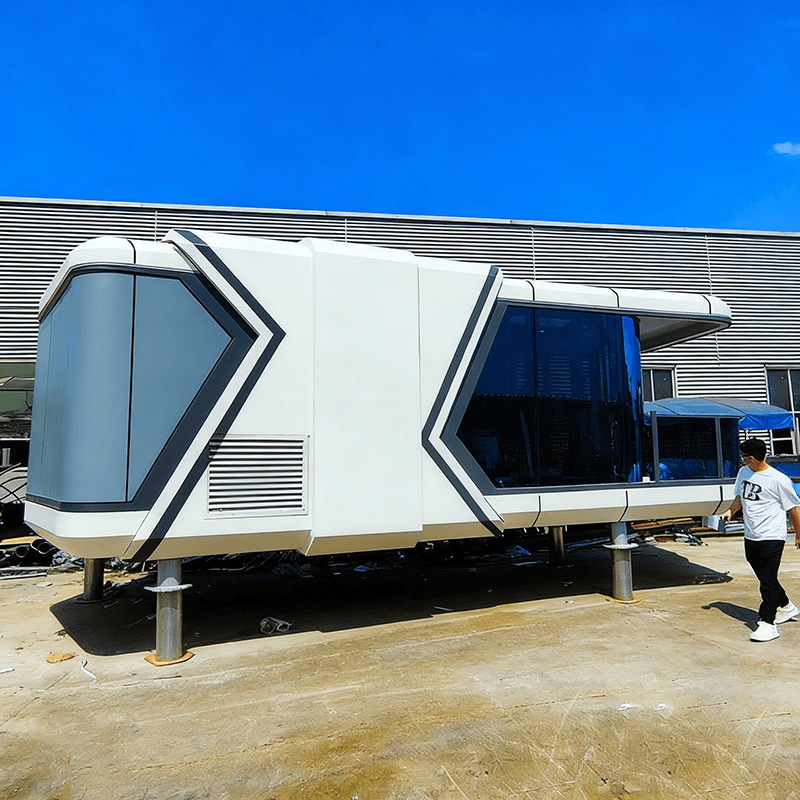
I. Flush-free Integrated Mobile Public Toilets During the high water level period of the Han River, the Urban Management and Law Enforcement Bureau of Caidian District urgently deployed 32 flush-free integrated mobile public toilets and installed them near flood control duty points and mass resettlement sites. These toilets adopt automatic packaging and waste collection technology, treating excreta through biodegradation or sealed packaging, with almost no odor. They do not require connection to external water sources or sewage pipelines, making them suitable for temporary, high-mobility usage scenarios. Their advantages lie in rapid deployment (they can be transported and installed as a whole) and environmental adaptability. They can be directly placed on hardened ground or simple platforms, meeting the basic toilet needs of flood control personnel and displaced residents.
II. Fixed Mobile Toilets (Requiring Foundation Construction) The Urban Management Bureau of Junshan District installed 36 mobile toilets overnight along a 14.35-kilometer flood control dike, which required land leveling, pipeline laying, and septic tank excavation. Although these toilets require a certain construction period, they can be connected to temporary drainage systems and treat waste through septic tank sedimentation, making them suitable for long-term flood control scenarios. Their characteristics include large capacity (serving nearly five thousand people) and strong stability. However, the terrain flatness and drainage outlet location need to be considered, and the construction difficulty varies with site conditions.
III. Flood Control Specialized Toilet Tents There are mobile toilet tents specifically designed for flood control on the market. They adopt a double-slope upright wall structure and are equipped with squat toilets, disabled toilets, urinals, and other facilities. They also integrate inductive lighting and solar panels for autonomous nighttime power supply. The tent dimensions are 3.9m in length, 2.4m in width, and 2.66m in ridge height, with a vestibule and ventilation openings at the bottom, balancing privacy and ventilation. These tents can be quickly set up in tent areas or temporary resettlement sites, suitable for short-term emergency use. Moreover, they are detachable and reusable, reducing long-term costs.
IV. Field Camping-style Mobile Restrooms Some earthquake and flood control temporary public toilets use tear-resistant fabrics and rubber soles, supporting customization of size and functions (such as adding sinks and storage cabinets) as needed. Their price ranges from 2,500 yuan to 4,500 yuan per unit, allowing flexible configuration based on the size of the flood control team. These restrooms are lightweight and easy to transport, suitable for decentralized deployment in wild areas or areas with poor transportation. However, they require regular cleaning of waste buckets or replacement of degradable bags, with the maintenance frequency depending on the usage intensity.



