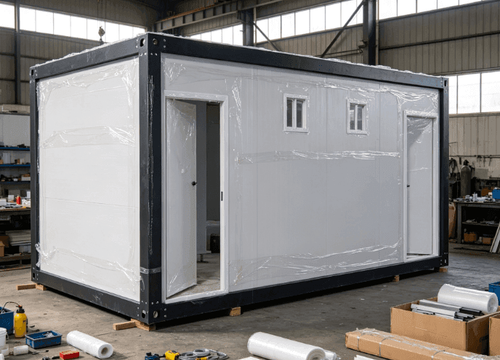
Finished Movable Public Toilet
A finished movable public toilet is a facility that can be moved as a whole and provides toilet services to the public, featuring advantages such as mobility, modularity, and ease of transportation.

I. Basic Definition and Examples A finished movable public toilet refers to a facility that can be moved in its entirety and is installed in fixed or temporary locations to provide toilet services to the public and clients. For example, a super-mini movable public toilet built with building blocks attracts attention with its technological design, while an economical and practical mobile toilet features a gray and white metal carved panel exterior, equipped with 8 squatting positions, independent toilet compartments, water and electricity fixtures, and sliding windows, balancing functionality and aesthetics.
II. Structural Composition Mobile toilets typically consist of the following core components:
- Fecal Treatment System: Includes storage tanks or disposal units for collecting or treating waste.
- Basic Structure: The floor provides stable support, with walls made of lightweight materials such as metal or plastic, and a roof with waterproofing capabilities.
- Sanitary Facilities: Equipped with squatting positions, toilets, washing facilities, and water tanks to meet basic usage needs.
- Mobility Devices: Depending on the type, these may include lifting hooks, powered wheels, or towing structures for easy transportation and installation.
III. Classification Methods
- By Structural Form:
- Monolithic Structure: Designed as an independent unit, suitable for spaces with limited area.
- Composite Structure: Composed of multiple modules that can be expanded into large toilet clusters.
- By Mobility Method:
- Lifting/Handling Type: Relies on lifting equipment or manual handling, suitable for short-term use.
- Powered/Towing Type: Equipped with an engine or towing device, capable of moving autonomously to the target location.
- By Sewage Treatment Method:
- Flush and Non-flush Suction Type: Uses water flushing or vacuum suction to clean waste, requiring regular maintenance.
- Recirculating Flush Type: Utilizes a filtration system to recycle water, reducing water consumption.
- Dry Packaging Type: Uses biodegradable bags to collect waste, requiring no water source, suitable for arid regions.
IV. Core Advantages Mobile toilets can be quickly deployed to temporary demand areas such as disaster sites, large events, and construction sites, avoiding the long construction周期 (Note: '周期' should be translated as 'cycle' or 'period', here using 'cycle' for better context) and high costs associated with traditional toilets. Their modular design supports flexible combinations, such as adjusting the number of toilet compartments to accommodate changes in foot traffic. Additionally, their reusability significantly reduces resource consumption, aligning with sustainable development principles.