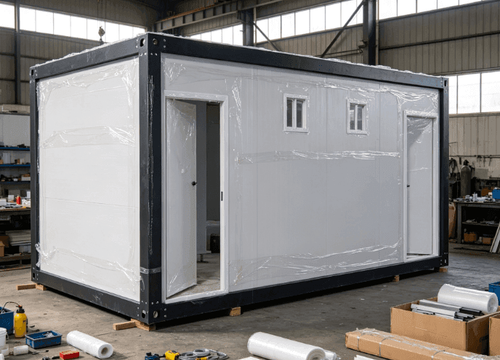
Mobile House Toilet at Experimental Primary School
Currently, no direct information about the 'mobile house toilet at Experimental Primary School' has been found, but we can provide a general科普 (popular science) explanation based on the common design principles, types, and prices of mobile house toilets.

The design of mobile house toilets requires comprehensive consideration of space, functionality, and durability. In terms of spatial layout, a compact design with 'dry and wet separation' is usually adopted. By reasonably dividing areas such as the toilet area and the hand-washing area, the maximum functionality can be achieved within a limited space. For example, the hand-washing sink can be designed as foldable or built-in to save space. Structural safety and waterproofing are the technical foundations. It is necessary to ensure that the main structure of the toilet is stable and can withstand vibrations and pressures during transportation and use. At the same time, waterproof materials should be used for the floor and walls to prevent leakage and ensure long-term use.
Material selection adheres to the dual standards of light weight and durability. The main frame is mostly made of aluminum alloy or high-strength plastic, which not only reduces weight for easy movement but also has sufficient strength. The materials for the walls and floors are selected to be wear-resistant and easy to clean, such as PVC panels or non-slip tiles, to adapt to high-frequency use scenarios.
The environmental maintenance system is related to user comfort. The ventilation design should ensure air circulation and reduce odors. The lighting system should meet nighttime use requirements while being energy-efficient and environmentally friendly. Some high-end models are also equipped with air conditioners or heating devices to adapt to different climatic conditions.
Water conservation and waste treatment are special technical considerations. Mobile toilets mostly use water-saving flushing devices, such as pneumatic flushing or vacuum flushing, to reduce water consumption. In terms of waste treatment, vacuum self-priming toilets use a vacuum pump to suck waste into a fecal storage tank. High-pressure air-water mixing toilets use high-pressure gas mixed with a small amount of water for flushing. Traditional gravity direct-discharge toilets rely on gravity for natural drainage. There are significant differences in drainage performance among different types.
In terms of price, mobile toilets vary depending on their type, specifications, and configurations. Basic models such as simple packing toilets have relatively low prices, starting at around 1250 yuan. Mid-range models such as high-pressure air-water mixing toilets cost around 1900 yuan. High-end models equipped with intelligent control systems and environmental protection treatment equipment can cost up to 7600 yuan or even more.