
Epidemic Isolation Container House
The epidemic isolation container house is a temporary building transformed from a container, used for epidemic prevention and isolation. It features rapid deployment, structural safety, and disassembly and relocation capabilities.
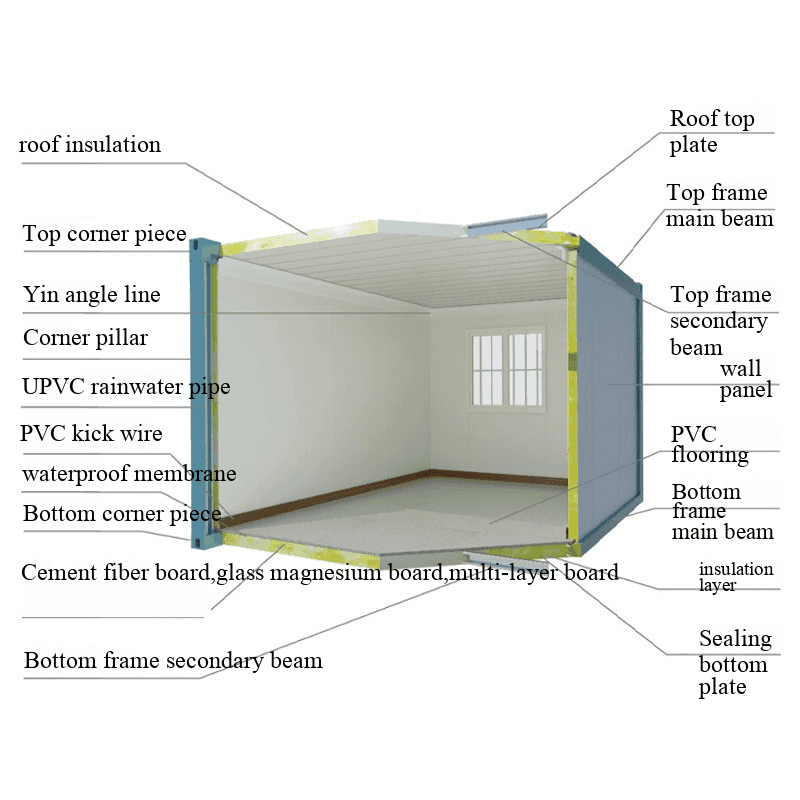
Structure and Materials
The epidemic isolation container house takes the container as its basic framework and uses a steel plate outer wall. It has the characteristics of corrosion resistance, no rust, and no cracking, with a service life of over 20 years. The interior wall panels often use materials such as rock wool boards, glass wool boards, or flame-retardant foam, which can provide both thermal insulation and fire protection. Some products also adopt a thickened fire-resistant rock wool and tin foil wrapping process to further enhance thermal insulation and fire resistance.
Functions and Configurations
Each container can be designed as a single room, equipped with a sink, toilet, shower, air conditioner, TV, water heater, and other equipment inside to meet basic living needs. At the same time, systems for water, electricity, air conditioning, and wired networks need to be set up to ensure normal life during isolation. Some products also use photovoltaic power generation technology to achieve self-sufficiency in energy and reduce dependence on external power sources.
Advantages and Characteristics
- Rapid Deployment: Using factory prefabrication + non-welded bolt fast-assembly technology, it can be assembled within 48 hours without on-site welding and complex civil engineering, meeting the urgent implementation needs of emergency scenarios.
- Structural Safety: It can withstand wind levels of 10 - 12, with an applicable temperature range of -10℃ to 50℃. It meets mandatory requirements such as Class A fire protection, thermal insulation, sound insulation, and waterproofing.
- Disassembly and Relocation: It supports non-destructive disassembly and repeated relocation. After disassembly and relocation, it will not deform, leak water, or experience performance degradation. It has a high recycling rate and is suitable for reuse in multiple scenarios.
- Strong Scene Adaptability: It can be quickly transformed into disaster relief settlement points, epidemic isolation points, temporary medical points, emergency command rooms, etc. It can be set up without a foundation in complex terrains.
Application Scenarios
Epidemic isolation container houses have been widely used in epidemic prevention and control, disaster relief settlement, temporary medical care, and other fields. For example, during the epidemic prevention and control in Hainan, several units under China Railway Group used container houses to quickly build makeshift hospitals and isolation points, effectively supporting medical emergency needs.



