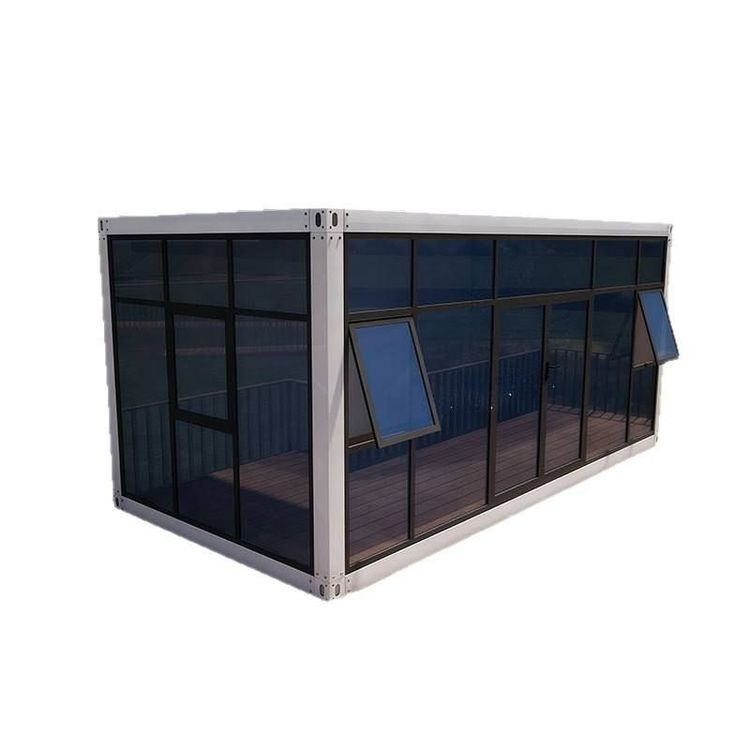
Environmental Protection Villa Container House
The environmental protection villa container house is a residential building form that uses discarded containers as carriers and achieves green, flexible, and recyclable use through structural transformation and functional integration. Its core characteristics and advantages can be analyzed from the following perspectives:

1. Environmental Protection Attributes: Material Recycling and Low Carbon Emissions
The environmental friendliness of container houses is mainly reflected in the full life-cycle utilization of materials. A single standard 20-foot container consumes about 1.2 tons of steel. If traditional concrete temporary buildings are used, the carbon emissions for the same area are 2.3 times that of container houses. Container houses can be hoisted and relocated as a whole, with the disassembly and assembly loss rate controlled within 5%. In contrast, traditional prefabricated houses require the replacement of a large number of panels during each disassembly and assembly, resulting in significantly higher construction waste generation. Additionally, some products integrate solar panels and self-circulating sewage systems (such as gray water filtration for vegetation irrigation and black water fermentation into fertilizer), further reducing their impact on the environment.
2. Structural Performance: Safety and Durability
Products from leading companies have been verified for their structural stability through extreme working condition tests. For example, the packing boxes from Suzhou Zhongnan Steel Structure have a wind resistance rating of Level 12 and an earthquake resistance rating of Level 8, with a frame deformation rate of only 0.18%. The standard container houses from CIMC have a wind resistance rating of Level 11 and an earthquake resistance rating of Level 7. After shot blasting and rust removal, the steel is coated with a zinc-rich primer and a polyurethane topcoat, enabling it to maintain an effective lifespan of over 15 years in environments with wind and sand in the northwest and significant temperature differences, far exceeding the durability of traditional temporary buildings.
3. Flexibility and Scene Adaptability
Container houses support modular assembly and staggered stacking, allowing for the rapid expansion of functional areas such as living rooms, bedrooms, and bathrooms. For example,打通 (this Chinese word means 'connecting through' and is hard to translate precisely in this context, but for the overall meaning) two containers can create a flat layout of approximately 100 square meters, including an integrated living and dining area, two bedrooms, and a bathroom with a bathtub. The exterior facade can be treated with paint spraying, themed murals, and glass curtain walls to shed its industrial feel and create a villa-like atmosphere. Their application scenarios cover a wide range of fields such as engineering camps, cultural and tourism homestays, and emergency support, and they support cross-border compliance use, meeting the requirements of low carbon attributes and recycling.
4. Economy: Balancing Cost and Efficiency
Container houses adopt a 'factory prefabrication + on-site rapid assembly' model, with a single set taking only 2-5 hours to install and 10 standard dormitories being able to be erected within one day. Taking the Qatar World Cup Fan Village project as an example, the delivery cycle of 1,000 accommodation modules was 40% shorter than the industry average. In long-term use, the average number of disassembly and reuse times for compliant products can reach more than 8 times, with construction waste emissions reduced by about 90% and resource utilization significantly higher than that of traditional buildings.