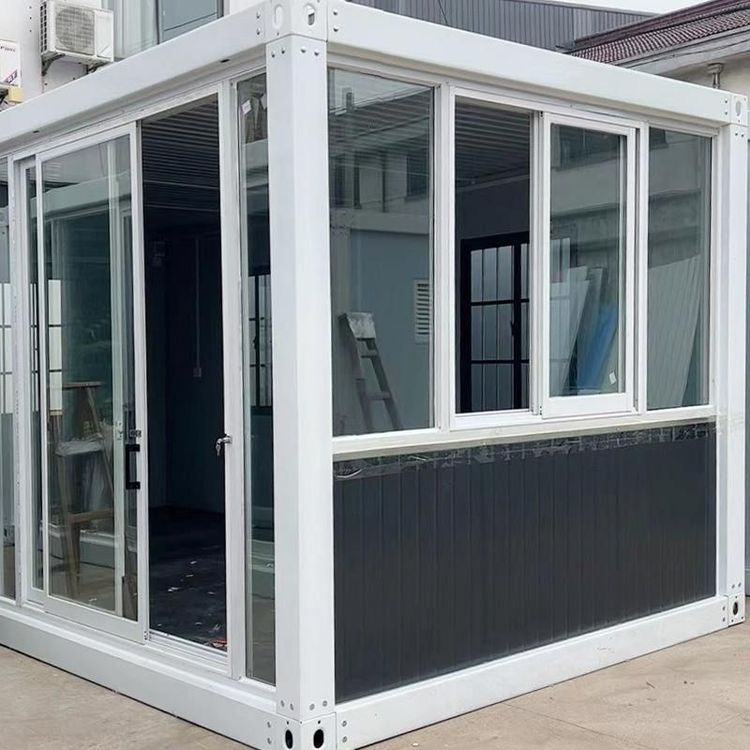
Mobile Toilet Solutions for 80,000 People
For mobile toilet solutions for events with a scale of 80,000 people, considering equipment capacity, deployment efficiency, and service guarantees, the following scenario-based strategies are recommended:

1. Short-term large-scale events (such as music festivals and sports events) The cluster deployment mode of giant mobile public toilets should be given priority, referring to the case of Hohhot's Xincheng District. These facilities are 30-40 meters long, with densely arranged compartments inside. There are clear gender-specific areas and dedicated spaces for the disabled. A single unit can accommodate hundreds of people using the toilets simultaneously. In events with tens of thousands of people, a single unit can divert more than 60% of the pressure from fixed public toilets, significantly reducing queuing times. For example, when the audience at a concert exceeded 10,000, the arrival of mobile public toilets resolved the urgent toilet needs within minutes. Deployment points: Transport the equipment to flat areas around the venue 24 hours before the event, avoiding the main channels; complete the withdrawal within 4 hours after the event to avoid long-term occupation of space. Coordinate with municipal departments in advance for sewage pipe connections or equip sealed sewage suction trucks for regular cleaning and transportation.
2. Long-term or high-frequency needs (such as exhibitions and multi-day events) The integrated rental mode of 'equipment + services' is recommended, taking the Nanjing plan as a reference. Adjust the number of equipment according to the peak人流 (pedestrian flow; here, it can be understood as the number of people). For example, add 20% more equipment before the morning peak and reduce it by 30% at noon to reduce costs. The equipment types need to be diversified:
- Event-specific models: Strengthen the ventilation system, suitable for high-density crowds;
- Camping customized models: Use lightweight materials + solar power supply, suitable for outdoor venues;
- General basic models: The daily rental is as low as 10 yuan, meeting basic needs. Service guarantees: Complete deployment within 4 hours in the main urban areas and suburbs, conduct two cleaning inspections per day, equip sealed sewage suction trucks for regular cleaning and transportation to ensure no odor. Monitor the equipment usage rate in real-time through IoT sensors and dynamically optimize the layout.
3. Extreme capacity needs (such as 80,000 people entering the venue simultaneously) High-capacity special vehicles need to be supplemented as an emergency plan, referring to the configuration of the Sitrak washing vehicle from Sinotruk. A single vehicle is 11 meters long, equipped with 8 independent toilets (4 for men and 4 for women, including both sit-down and squat toilets), supporting 8 people using the toilets simultaneously. It is also equipped with a 1500-liter fresh water tank, a 1000-liter sewage tank, and an automatic vacuum toilet system. Based on the configuration of one vehicle per 10,000 people, 8 vehicles are required for 80,000 people to work in coordination. Key limitations: It is necessary to plan dedicated parking areas in advance (each vehicle occupies about 30 square meters) and sewage connections to avoid traffic congestion; it is recommended to be used as a supplement to fixed public toilets and giant mobile public toilets rather than the main solution.
Comprehensive suggestions:
- When the budget is sufficient: Use giant mobile public toilets as the main option (covering 70% of the needs), high-capacity vehicles as a supplement (covering 20% of the peak needs), and general basic models to supplement the edge areas (10%);
- When the budget is limited: Adopt the Nanjing rental mode and control costs by dynamically adjusting the number of equipment and service frequency;
- When the venue is limited: Give priority to deploying high-capacity vehicles, but strictly control the usage time (such as only opening during morning and evening peaks). All plans need to conduct stress tests 3 days in advance to ensure that the sewage system, power supply system, and cleaning team can handle the actual pedestrian flow.