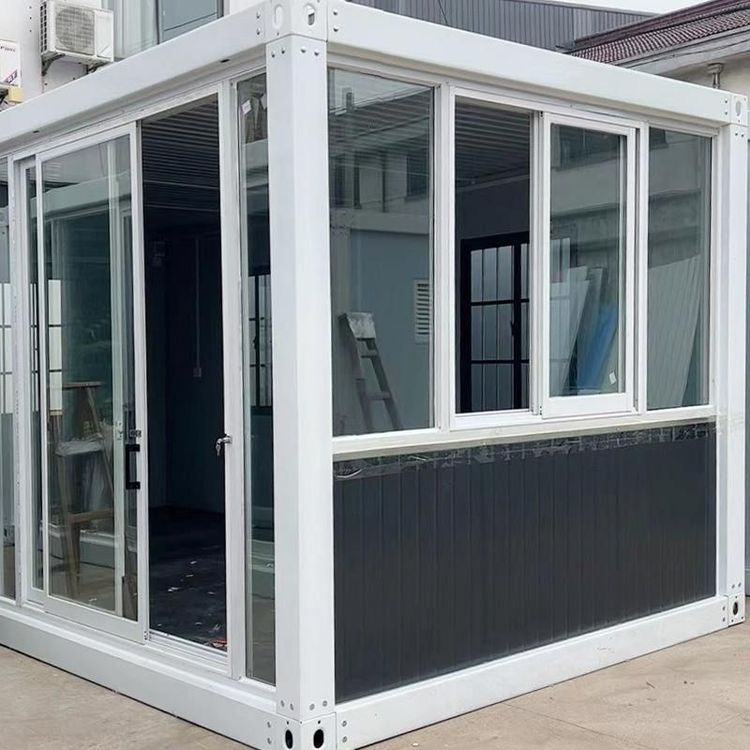
Earthquake Container Mobile House
Earthquake container mobile houses are modular temporary living facilities designed for rapid deployment and easy transportation in response to disasters such as earthquakes. They feature portability, low cost, and strong disaster resistance, playing a crucial role in emergency support and post-disaster resettlement scenarios.

1. Structural Design and Performance Characteristics
Earthquake container mobile houses typically employ lightweight steel frame structures, offering high strength and resistance to deformation. For example, container houses used in the Dingri earthquake-stricken area in Tibet can withstand 8.0-magnitude earthquakes and 12-level gales, ensuring structural safety in extreme environments. Some products integrate insulation layers and soundproofing materials, adapting to low-temperature environments (such as minus 30 degrees Celsius) and meeting basic survival needs through fireproof and waterproof designs. Japan's 'Earthquake Shelter蜗居' (Earthquake Shelter蜗居, here '蜗居' is kept as a specific term, but in a more natural English context, it might be translated differently like 'Compact Earthquake Shelter') is also equipped with solar power generation systems, lithium-ion battery energy storage devices, and water makers, enabling self-sufficiency in energy and drinking water supply, supporting independent living for two adults for one month.
2. Transportation and Deployment Efficiency
Foldable containers are the mainstream choice for emergency scenarios, with their core advantage being the convenience of transportation and installation. For example, products from Suzhou Zhongnan Steel Structure, when folded, have a volume only one-fifth of their expanded state, allowing a single truck to carry 20 sets, with the transportation cost per set as low as 150 yuan (for a 300-kilometer journey). In terms of expansion efficiency, hydraulic automatic expansion structures can reduce single-person operation time to 5 minutes, while manually assembled products require more than 10 minutes. This efficiency was evident in the Linxia earthquake in Gansu: container houses installed by China Construction Eighth Engineering Division had pre-embedded water and electricity pipelines, requiring only power connection after hoisting, significantly shortening the waiting time during the post-disaster transition period.
3. Scenario Adaptation and Functional Expansion
Container mobile houses can be quickly transformed into disaster relief command rooms, temporary medical stations, or isolation restrooms according to needs. For example, some resettlement sites in Tibet enhanced living comfort by adding heaters, electric blankets, and smart water supply platforms (supplying over 1,000 tons of water daily); Japanese products integrate microbial decomposition toilets and simple kitchens, supporting long-term self-sufficient living. Additionally, the modular design supports damage-free disassembly and reuse, with high recycling rates, meeting the dual demands of cost and sustainability in emergency scenarios.
4. Practical Application Cases
- Dingri Earthquake in Tibet: Twenty foldable container houses donated by Anhui Zeyu Color Steel arrived at the epicenter within 10 hours and were completed within one day, ensuring living needs for nearly 200 people.
- Linxia Earthquake in Gansu: Nearly 1,000 container houses were deployed along the Yellow River, equipped with built-in power supplies, sanitary facilities, and air conditioning brackets, addressing living needs during a three-month cold winter.
- Earthquake Shelter in Japan: The 'Earthquake Shelter蜗居' was transported by helicopter to areas without water or electricity, expanding into a two-story building in four and a half minutes, demonstrating emergency capabilities under extreme conditions.