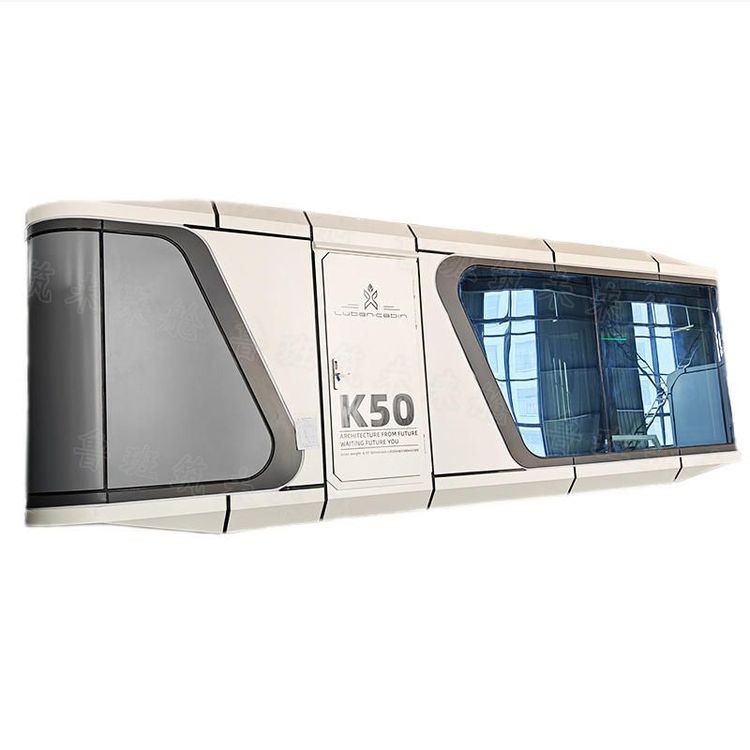
Deqing Container House Construction
The development of container house construction in Deqing County mainly revolves around the promotion of prefabricated building policies and the construction of new rural demonstration communities. Meanwhile, local enterprises in Deqing are not directly involved in the production of container houses, but external enterprises provide relevant solutions.
I. Policy-Driven Development of Prefabricated Buildings
The Office of the People's Government of Deqing County issued the 'Revised Implementation Plan for Promoting the Development of Prefabricated Buildings in Deqing County,' which clearly states that starting from 2026, the proportion of prefabricated buildings in newly constructed building areas across the county must closely follow the work requirements of the province and city, and establish a development mechanism of 'market-led, government-driven, and social participation.' The plan emphasizes that government-invested projects should give priority to prefabricated buildings. For example, new housing construction projects are required to compile special content on prefabricated buildings during the feasibility study stage, while non-government-invested projects should increase the proportion of prefabricated buildings through policy guidance. This policy provides policy support for the application of modular buildings such as container houses in Deqing, especially since their standardized and reusable disassembly and assembly characteristics align with the core requirements of prefabricated buildings.
II. Modular Applications in New Rural Demonstration Communities
The new rural demonstration community in Maxu Town, Deqing County, is the first cross-village centralized housing project in the province. It adopts the 'four unifications' standard (facade, unit area, housing design, and overall structure) to build row houses and multi-story residential buildings, offering a choice of unit sizes ranging from 90㎡ to 240㎡. The project guides villagers to withdraw from inefficient homesteads through the 'relocation and rights exchange' model and replaces them with centrally constructed row houses. It is equipped with facilities such as a comprehensive elderly care service center and a cultural and sports park, creating a '15-minute living circle.' Although the project does not explicitly mention container houses, its modular design concept is highly compatible with the rapid deployment and flexible combination characteristics of container houses, providing practical references for the adoption of container houses in similar projects in the future.
III. External Enterprises Provide Container House Solutions
Currently, local enterprises in Deqing are not directly involved in the production of container houses, but external enterprises such as Shandong Jinda Lvjian Integrated Housing Co., Ltd. and Sichuan Kuaizhu Integrated Housing Co., Ltd. have formed mature product lines of container houses. For example, Shandong Jinda Lvjian's packing-box units adopt standardized steel structure modules, supporting the completion of basic installation within 24 hours and adapting to temperature differences ranging from -30℃ to 50℃. Sichuan Kuaizhu's foldable containers solve the problem of water leakage through a V-shaped male-female interlocking design, reducing transportation costs by more than five times compared to ordinary containers. The product characteristics of these enterprises (such as rapid deployment, economic and environmental friendliness, and flexible configuration) can meet the needs of scenarios such as temporary housing and cultural and tourism facilities in Deqing, and may be introduced to the local market through cooperation or investment attraction in the future.
IV. Potential Application Space in the Renovation of Old Residential Communities
The 2024 renovation project of old residential communities in Deqing County involves the updating of infrastructure such as roads, water supply and drainage, and fire protection facilities, but does not explicitly include container houses. However, the modular characteristics of container houses make them suitable for scenarios such as temporary offices and community service stations, and they may serve as supplementary facilities in the renovation of old residential communities in the future, improving renovation efficiency and functionality.