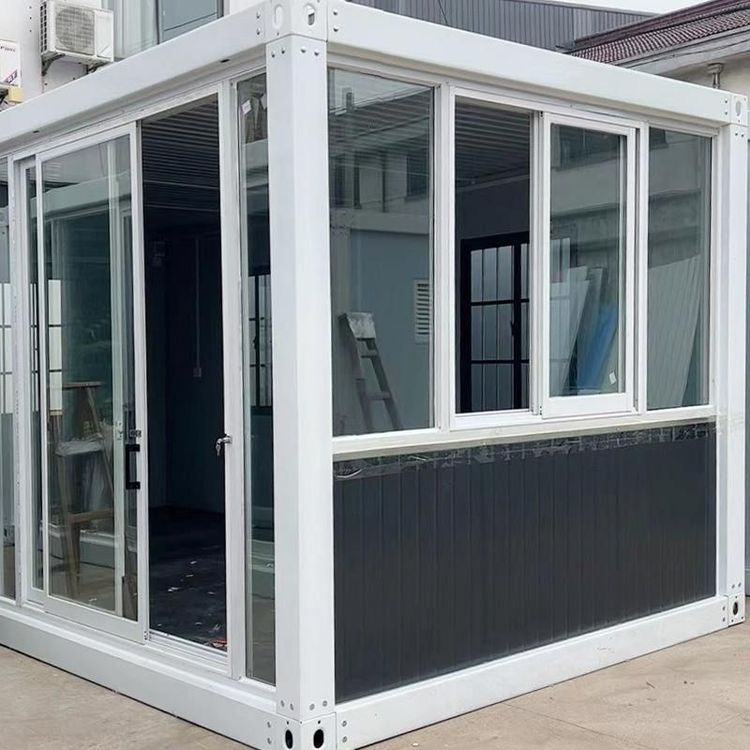
Customized Mobile Toilets for Construction Sites
Mobile toilets for construction sites can be customized in various ways, allowing for flexible selection based on actual needs.

I. Customization Basis
The customization of mobile toilets for construction sites should be centered around actual usage requirements. For example, a customer in Zhejiang customized mobile toilets for factory workers. Given that there were significantly more male workers than female workers in the factory, the蹲位 (toilet stalls) allocation was designed accordingly: only one stall for women and seven stalls for men. This customization directly addressed the issue of usage efficiency caused by gender ratio differences, avoiding resource waste or shortage. In similar scenarios, if there are more female workers on the construction site, the number of female stalls can be increased accordingly; if there are special groups (such as disabled individuals) on the site, barrier-free facilities such as handrails and low-positioned toilets can be added.
II. Customization of Structural and Functional Modules
The components of mobile toilets include fecal sewage storage tanks (or disposal devices), floor slabs, sanitary ware, walls, washing equipment, water tanks, roofs, and mobile devices, among others. Each module can be adjusted according to needs. For example:
- Structural Form: If space is limited on the construction site, a single-unit mobile toilet can be chosen, which occupies a small area and offers high flexibility; if more people need to use it simultaneously, a composite-structure mobile toilet can be selected, which expands space through modular assembly.
- Mobility Method: If the toilet position needs to be frequently adjusted within the construction site, a lifting or transportable mobile toilet can be chosen, which relies on manual or small equipment for movement; if it needs to be transferred across construction sites, a powered or towed mobile toilet is more suitable, equipped with an engine or towing device for rapid transportation.
- Sewage Treatment Method: Water-flush mobile toilets require a water tank and sewage pipeline, suitable for construction sites with sufficient water sources and good sewage disposal conditions; waterless suction mobile toilets use a vacuum pump to suction feces, requiring no water source, suitable for water-scarce areas; recirculating water-flush mobile toilets reuse water resources through a filtration system, offering high environmental protection; dry-packing mobile toilets use biodegradable film bags to encapsulate feces, requiring no water flushing, suitable for temporary or remote construction sites.
III. Customization Process and Precautions
Before customization, parameters such as the number of workers on the site, usage frequency, and environmental conditions (such as temperature and humidity) should be clarified to design reasonable stall quantities, sewage disposal plans, and material durability. For example, corrosion-resistant materials should be selected in high-temperature areas, and insulation layers should be added in cold areas. Additionally, the customization cycle is typically 15-30 days, and planning should be done in advance to avoid affecting the construction schedule.