
Custom Container House Sizes
Custom container houses offer a wide range of size options, with common specifications covering different combinations from 3m × 3m to 12m × 3m, depending on the intended use, transportation conditions, and functional requirements.
I. Standardized Size System
The size design of container houses is usually based on a modular concept to adapt to different scenarios. The conventional size for domestic trade is 3m × 6m, covering an area of approximately 18 square meters, suitable for single-room homestays, temporary offices, etc. The size range for foreign trade is broader, extending from 5.8m × 2.2m to 11.5m × 2.2m, corresponding to the two main models of 20-foot and 40-foot containers, with areas of approximately 12.98 square meters and 25.96 square meters, respectively. In addition, the standard width of a single container module is 3m, with lengths available in 3m, 6m, 9m, or 12m, supporting arrangement, combination, and stacking to form multi-functional spaces. For example, Apple Pod containers can adapt to a variety of needs from single-room homestays to large public spaces through a size system that combines standardization and flexibility.
II. Custom Sizes for Special Scenarios
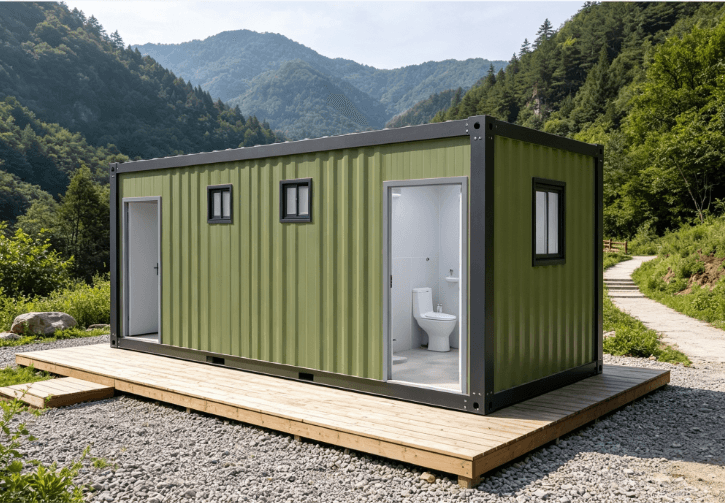
For specific purposes, the size of container houses can further break away from conventional norms. For example, common sizes for on-site residential containers include 3m × 3m × 2.8m (suitable for 2 people to live in or as a guard room or small warehouse), 6m × 3m × 2.8m (can accommodate 10 people, used as workers' dormitories, toilets, or kitchens), and 7m × 3m × 2.8m (used for two-story dormitories with added corridors and canopies). The Double-Wing Expandable Container employs a space-conversion design, collapsing the side spaces during transportation (e.g., in a 20-foot configuration) and expanding to form an indoor usable area of approximately 36 square meters, balancing transportation efficiency with practical usage needs.
III. Core Principles for Size Selection
- Functional Suitability: Determine the area based on the number of occupants, equipment placement, or commercial use. For example, a temporary office can choose the standard size of 3m × 6m, while a large exhibition space requires the combination of multiple containers.
- Transportation Constraints: Foreign trade containers must comply with international transportation standards (e.g., 20-foot and 40-foot), while domestic trade can be more flexible. Foldable container houses can significantly reduce transportation costs by compressing their height (e.g., to 41 cm when folded).
- Expandability and Combinability: The modular design supports horizontal splicing or vertical stacking. For example, stacking two layers of 3m × 6m containers forms a duplex structure, or horizontally splicing multiple units creates an open-plan office area.



