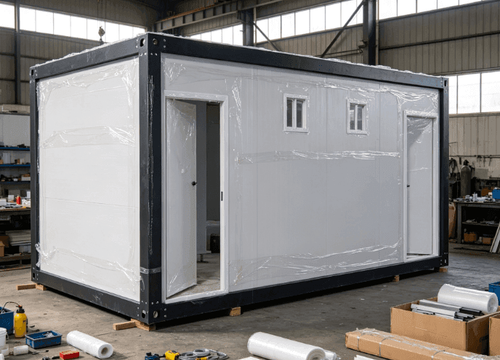
Container Renovation House Saves Money
Renovating container houses indeed saves money, primarily reflected in initial costs, construction duration, flexibility, and environmental friendliness.

Lower Initial Costs: As industrial standardized products, containers have low mass production costs, and second-hand containers are even more affordable. For example, someone spent only 4,000 yuan to purchase a standard second-hand container and, through self-design and decoration, ultimately created a fully functional living space at a total cost much lower than that of a traditional brick-and-mortar house. Additionally, container houses do not require complex foundation treatments, further saving on civil engineering costs.
Short Construction Duration and Low Labor Costs: The modular nature of containers provides a rapid assembly advantage. Renovating a single container into a house typically takes only a few weeks, and the construction process is simple, eliminating the need for professional construction teams and significantly reducing labor costs. For instance, Beijing Falilai Mobile Panel House Co., Ltd. offers container mobile homes that can be shipped within three days, with extremely efficient on-site assembly.
Flexibility and Relocatability Reduce Long-Term Costs: Container houses can be relocated or recombined as a whole to meet different scenario requirements. For example, after the completion of a cultural tourism project, containers can be moved to a new location for continued use, avoiding resource waste. This 'relocatability' extends the building's service life and indirectly saves on repeated construction costs.
Environmentally Friendly Materials and Energy-Efficient Design Reduce Operational Costs: Modern container renovations commonly use thermal insulation materials, energy-efficient doors and windows, and solar systems to reduce energy consumption. For example, an eco-cottage in South Africa combines containers with spruce wood, along with waterless toilets and rainwater collection systems, achieving a self-sufficient, low-carbon lifestyle. In the long run, such designs can significantly reduce water and electricity expenses.
Customization Avoids Excessive Decoration: Container houses can be precisely designed according to needs, avoiding material waste common in traditional decorations. For example, someone transformed a container into a tea room, achieving a harmonious blend of functionality and aesthetics through the combination of thermal insulation layers, wooden door frames, and large glass windows, with costs kept within a reasonable range.