
Container House Iron Roof
The iron roof of container houses typically uses high-strength weathering steel or galvanized steel as the main material, with a design focus on structural stability, thermal performance, and durability. The specific features are as follows:
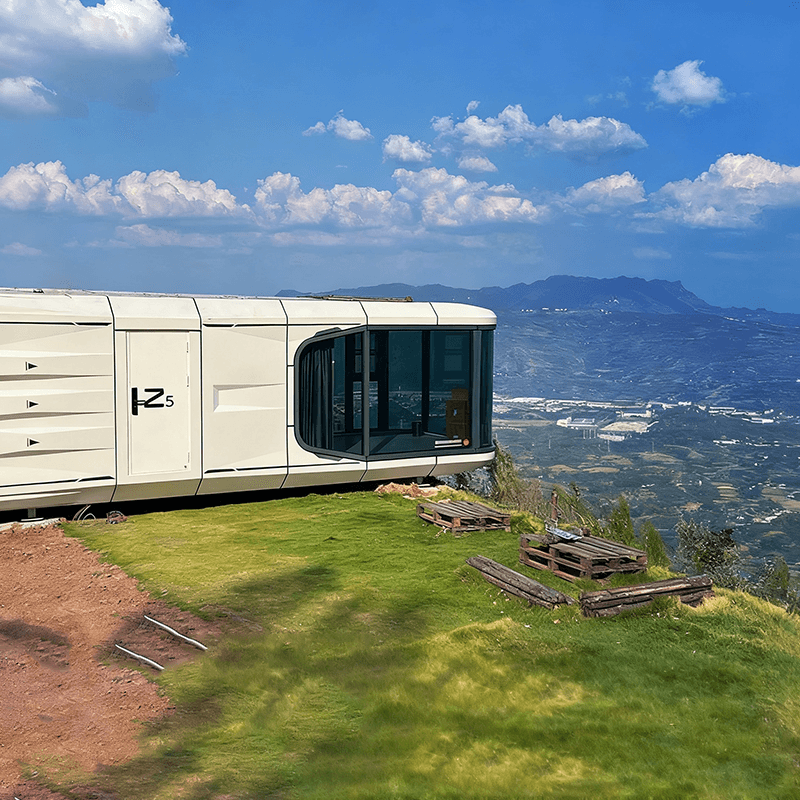
Structural Stability
The core support structure of the iron roof of container houses often employs high-strength weathering steel (such as Q355B grade), with a yield strength approximately 30% higher than that of ordinary carbon steel. For example, Yiqi Company forms a self-balancing system through rigid connections between corner fittings and side beams, enabling a single container to remain stable even when the length-to-width ratio approaches 2:1. The longitudinal corrugated plate design of the iron roof not only bears the roof load but also disperses stress through its corrugated geometry, avoiding local buckling and reducing the need for additional reinforcement, resulting in a material usage reduction of about 15%.
Thermal Performance
The thermal performance of the iron roof directly affects indoor comfort. Some designs adopt a three-layer composite structure of "rock wool - air layer - galvalume sheet": the rock wool layer is 75-100 millimeters thick, with fibers arranged perpendicular to the heat flow path, and a thermal conductivity below 0.040 W/(m·K); the 5-millimeter air layer in the middle inhibits convective heat transfer through a closed cavity, with an overall heat transfer coefficient (U-value) below 0.5 W/(m²·K). This design reduces the risk of condensation in low-temperature environments and extends the service life of the steel structure. Another design uses a 0.6-millimeter-thick galvanized sheet on the outer layer of the iron roof to resist wind and sand erosion, with 80-100 millimeters of rock wool in the middle and a PVC-coated steel sheet on the inner layer to reduce thermal radiation, resulting in a reduction in indoor temperature fluctuations of about 40% compared to traditional color steel plate houses.
Durability and Corrosion Resistance
The durability of the iron roof depends on the material and coating process. Hot-dip galvanizing provides a longer corrosion-resistant life than cold-dip galvanizing, especially in areas with large diurnal temperature differences and significant humidity changes, where the coating quality directly determines the corrosion rate. Some iron roof designs further reduce the risk of corrosion by adding an elevated layer to block the conduction of ground cold bridges. For example, Qingdao Delaos Container Houses adopt an A1-grade fire-resistant design for the iron roof with rock wool, combining durability and safety.
Installation and Adaptability
The installation of the iron roof needs to be coordinated with the overall structure. For example, welded containers are welded into shape as a whole in the factory, with the roof load transferred through the side wall columns to the bottom beams and then evenly distributed to the ground, suitable for frequent lifting and moving; bolted modular containers require checking the tightness of each connection node to ensure overall stability.
You may also like

Portable Toilet Used in 2026: Buying Guide & Recommendations
Read More
Portable Toilet Custom Explained: How to Choose the Right One
Read More
Top Portable Toilet Smart Manufacturers: How to Choose a Factory Partner
Read More