
Container Chinese-Style Mobile House
The container Chinese-style mobile house is an independent mobile office or living unit that uses standard containers as carriers and is transformed to have a Chinese style or meet Chinese usage requirements. The following is an introduction from aspects such as structure, application scenarios, advantages, and market trends:
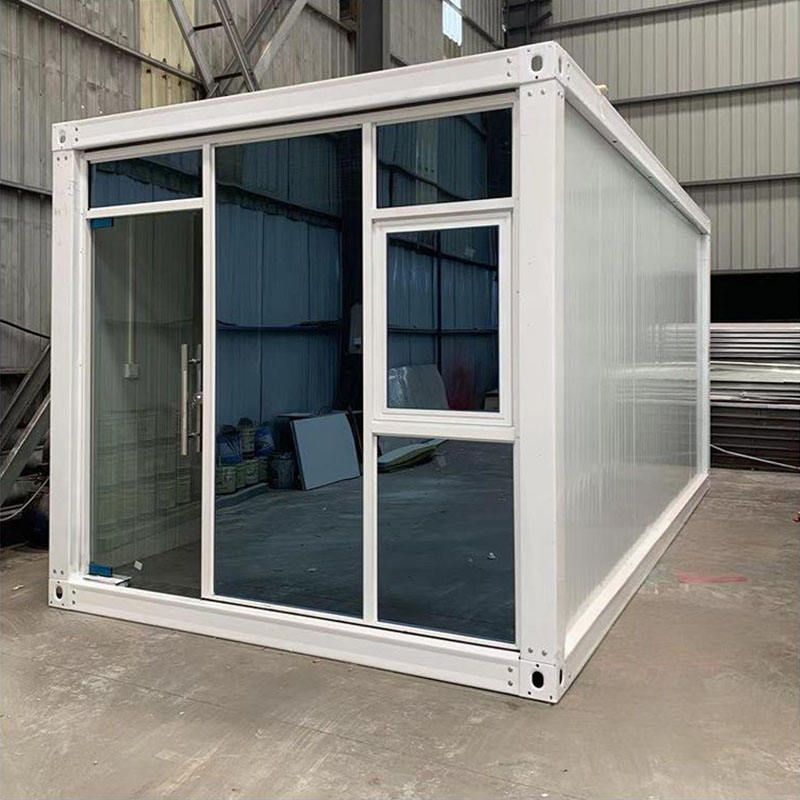
I. Structural Features
The container Chinese-style mobile house takes standard containers (common specifications are 20-foot and 40-foot) as the basic structure and is transformed into an independent functional unit. Its core structure includes a fully steel structural frame, which performs excellently under extreme working conditions (such as coastal typhoons of force 12 and high-intensity earthquakes of magnitude 8). The frame deformation rate is far lower than the industry's qualified threshold, ensuring the stability and safety of the house. Some products also adopt an expandable design, adding side or end expansion modules on the basis of the container. After expansion, the usable area can be increased by 30%-50%, meeting the long-term on-site office or living needs of those with high requirements for spatial comfort.
II. Application Scenarios
The container Chinese-style mobile house has a wide range of application scenarios, including but not limited to:
- Project Departments and Construction Site Command Centers: Taking advantage of its sturdy structure and convenient transportation, it can be quickly deployed at construction sites to provide temporary office space for project management.
- Emergency Support and Temporary Rescue: In natural disasters or emergencies, it serves as a temporary command post or a storage point for rescue supplies. Its characteristics of rapid deployment and low cost are particularly prominent.
- Cultural Tourism and Commercial Supporting Facilities: Through personalized customization of the exterior facade and internal functional transformation, it can be adapted to multiple scenarios such as engineering camps, mobile businesses, and cultural tourism accommodations, enhancing the cross-scenario versatility of modular products.
III. Advantage Analysis
- Rapid Deployment and Efficient Transportation: The container Chinese-style mobile house can be used as a single unit or combined with multiple units. During transportation, its volume is compressed, and it can be quickly expanded after arrival. The expansion time for a single unit can be controlled within 30 minutes, significantly improving the project start-up speed.
- Low-Carbon Circulation and Resource Conservation: It supports multiple disassembly and reassembly for reuse, reducing construction waste emissions by about 90% compared with traditional fixed temporary buildings and having a higher resource utilization rate, which is in line with the policy orientation of green construction.
- Cost Control and High Cost-Effectiveness: Compared with traditional construction methods, the container Chinese-style mobile house achieves significant savings in terms of construction period, labor, and materials, and has a relatively low operation and maintenance cost throughout its life cycle.
IV. Market Trends
With the refined development of the modular building industry, the container Chinese-style mobile house is moving towards the directions of low-carbonization, compliance, and scenario-based applications. Overseas market demand maintains relatively rapid growth, and products with multiple reuse capabilities, cross-border export qualifications, and low-carbon attributes are gradually becoming the mainstream procurement direction.



