
Construction Site Professional Mobile Toilet
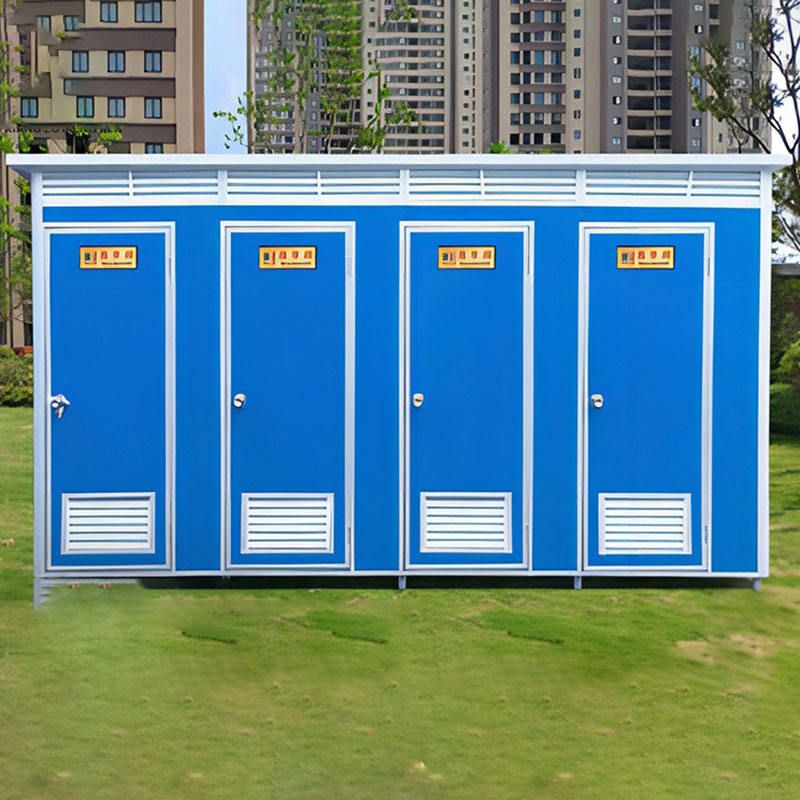
Construction site professional mobile toilets are facilities designed to meet the temporary and periodic toilet needs of construction sites and other similar locations. They are cost-effective, have a long service life, and can be customized according to actual requirements.
I. Basic Components
Construction site professional mobile toilets typically consist of core components such as fecal sewage storage tanks (or disposal units), floor slabs, sanitary ware, walls, washing equipment, water tanks, roofs, and mobile units. Among them, the fecal sewage storage tank is used to collect excreta, and some models are equipped with disposal units for preliminary purification. The walls are mostly made of lightweight materials (such as metal carved panels and bamboo-wood fiber panels) to balance strength and portability. The roof design needs to consider waterproofing and heat insulation performance. The mobile units are divided into lifting, towing, or power-driven types according to their structural forms to ensure convenient transportation.
II. Classification Methods
- By structural form: They are divided into single-unit structures and composite structures. Single-unit structures have strong independence and are suitable for scattered layouts. Composite structures are composed of multiple modules and can flexibly expand the number of squatting positions.
- By mobility method: They include lifting and handling types (relying on lifting equipment), power-towing types (with their own power or connectable to vehicles), and manual handling types (suitable for small-scale scenarios).
- By sewage treatment method:
- Water-flushing and non-water-flushing suction types: They rely on water sources for flushing, and the sewage needs to be regularly pumped away. The non-water-flushing type reduces odors through vacuum suction but has higher costs.
- Recirculating water-flushing type: Equipped with a filtration system, it enables the reuse of water resources and is suitable for water-scarce areas.
- Dry-packing type: It uses biodegradable bags to collect excreta, requiring no water source or sewage pipes, and has outstanding environmental protection performance.
III. Customized Applications
Construction sites can customize mobile toilets according to requirements such as the ratio of male to female workers and usage frequency. For example, a factory with a high proportion of male workers customized a model that retained only one female squatting position and increased the number of male squatting positions to seven. There is also a 4+1 stepped design, which includes four squatting positions and one open washroom. The exterior wall is made of heat-insulating and flame-retardant materials, and the interior is equipped with a bathroom cabinet, anti-slip tiles, an exhaust fan, etc. The side door is made of titanium-magnesium alloy to enhance durability. Such customized solutions can optimize space utilization and improve the user experience.
IV. Advantages and Applicability
Through modular design, construction site professional mobile toilets can be quickly deployed and dismantled, adapting to the characteristics of short construction periods and frequent site changes. Their cost-effectiveness is reflected in low maintenance costs and a long service life, while their diverse classifications meet the special needs of different environments (such as water-scarce and extremely cold areas), making them the mainstream choice for sanitary facilities at construction sites.


