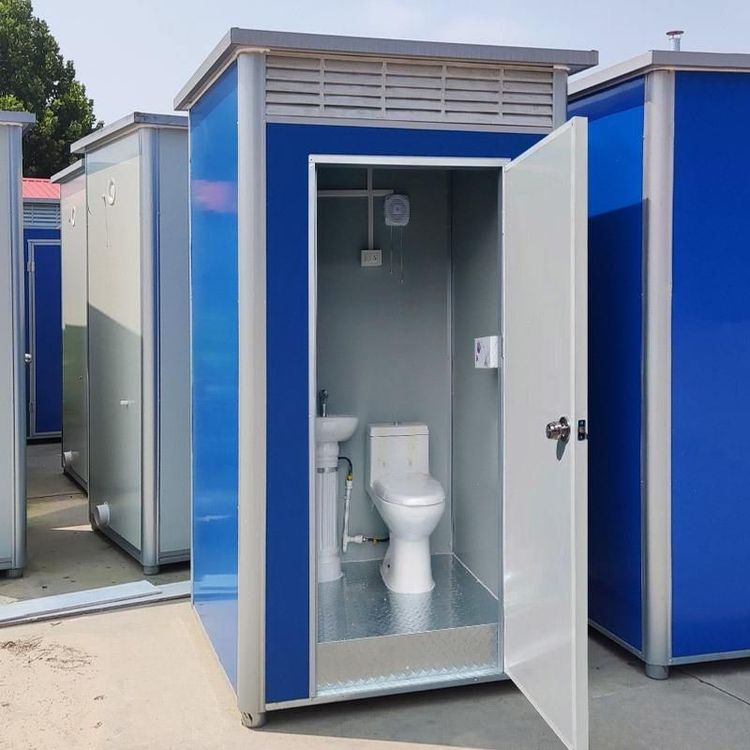
Construction Site Mobile Toilet Solution
The construction site mobile toilet solution requires comprehensive planning from five aspects: site selection and layout, structural design, installation and operation and maintenance, leasing services, and technical advantages. The specific points are as follows:

1. Site Selection and Layout
Location Selection: Priority should be given to placing the toilets on the inner side of the construction site living area, maintaining a distance of 30-50 meters from dormitories and canteens, avoiding foundation pits, high-risk work areas, and the prevailing summer wind direction. If there is a surrounding wall, they can be placed adjacent to it to create visual shielding and wind direction guidance. Underground Pipeline Confirmation: Review drawings to ensure the selected area is free of cables, gas pipelines, or main water supply lines, and mark their positions. Ground Treatment: Clear away loose soil and gravel, then compact the foundation to a compaction degree of no less than 90%. Pour a 10-15 cm thick C20 concrete cushion, with an area extending at least 30 cm beyond the outer contour of the toilet base on each side. If repeated relocation is required, prefabricated reinforced concrete slabs or steel roadbed boxes can be used. The foundation surface should have a drainage slope of 2%-3%, sloping towards the catch basin on the side of the sewage outlet.
2. Structural Design
Main Materials: It is recommended to use an integral steel structure frame combined with high-density polyethylene (HDPE) wall panels or color-steel sandwich panels, which have the characteristics of light weight, high strength, corrosion resistance, and a fire rating of Class A. Dimensions: The recommended dimensions are 1.2 meters in length, 1.2 meters in width, and 2.4 meters in height, with an internal clear height of no less than 2 meters. Functional Configuration: It should include non-slip floors, independent flushing systems, and optionally, models with insulation functions for winter. Depending on needs, add barrier-free facilities (such as handrails, non-slip pedals), female-only compartments, or ventilation and deodorization devices; some new models are equipped with solar power systems, biological degradation, or chemical treatment technologies to achieve preliminary decomposition of waste.
3. Installation and Operation and Maintenance
Installation Process: Use a crane or forklift to position the toilet on the concrete cushion, adjust the levelness with a spirit level, and equip the equipment chassis with heavy-duty tires or sliding bases to adapt to uneven ground. Daily Maintenance: The leasing party is required to clean at least once a day and disinfect twice a week. The construction site should arrange for a dedicated person to record usage and check the flushing system; the maintenance cycle should be set according to the frequency of use. Emergency Management: Prepare 1-2 spare toilets to meet sudden demands, check the drainage hole patency during heavy rain, and select models with reinforced bases for extreme weather conditions.
4. Leasing Service Points
Capacity Adaptation: The number of toilets should be selected based on the number of workers on the construction site, with an additional 20% reserve during peak construction periods. Leasing Price: The daily rental fee ranges from 100-300 yuan per unit, with an 80% discount for monthly rentals. The deposit is 20%-30% of the total equipment price. Compliance: Confirm that the leasing party holds an Environmental Sanitation License and that the toilets comply with the Urban Public Toilet Design Standard (CJJ14-2016).
5. Technical Advantages
Environmental Protection: The advanced treatment system reduces the volume of solid waste by more than 60%, and some models are equipped with a graywater recycling system, saving 70% of water consumption. Economy: It avoids fixed asset investment, reduces civil engineering and demolition costs, and the fees include equipment usage, transportation, and maintenance costs. Intelligence: New models integrate IoT monitoring systems to monitor usage status and hygiene conditions in real-time, and some are equipped with air quality sensors to automatically adjust ventilation.