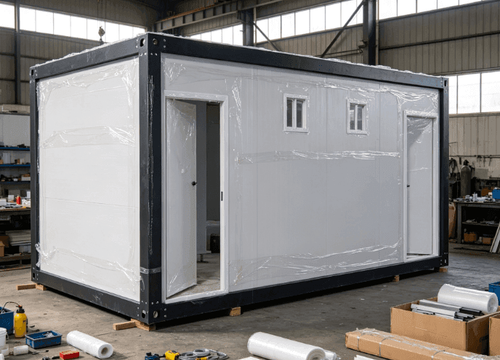
Cracks in Concrete Prefabricated Houses
The causes of cracks in concrete prefabricated houses are complex and diverse, mainly involving construction, design, and the inherent characteristics of concrete. Minor cracks require timely repair.
Construction Factors
- Excessive Mixing and Transportation Time: When the mixing and transportation time exceeds the specified limits, excessive evaporation of water in the concrete reduces its fluidity and slump, leading to irregular shrinkage cracks during hardening.
- Improper Vibration Operations: Inadequate or uneven vibration, or vibration times that are too long or too short, can result in insufficient concrete strength, uneven distribution, or layering, thereby causing cracks.
- Unauthorized Changes to Mix Proportions: Unauthorized increases in water content or water-cement ratios can severely affect the performance and stability of concrete, significantly increasing shrinkage during hardening and resulting in irregular cracks.
- Disorganized Construction Management: Unreasonable construction techniques, such as unrestricted stacking of machinery and materials, can damage completed parts of the project and increase the risk of cracks.
- Other Construction Issues: Excessive concentrated construction loads or early loading, inadequate stiffness or stability of formwork support systems, premature formwork removal, insufficient curing (inadequate time or improper methods), improper control of the steel reinforcement cover, unreasonable layout of embedded pipelines, uneven vibration of concrete, or improper troweling techniques can also lead to the appearance of cracks.
Design Factors
- Insufficient Floor Thickness: If the floor thickness design does not meet standards, it cannot effectively bear loads, leading to cracks.
- Missing Reinforcing Bars: The absence of reinforcing bars (such as radial bars) at the ends of spans or corners results in insufficient structural strength and the formation of cracks.
- Inadequate Consideration of Temperature Stress: Failure to adequately consider temperature stress, lack of thermal insulation layers and temperature joints, can lead to cracks due to temperature changes.
- Improper Design of Embedded Holes: Improperly shaped embedded holes can cause stress concentrations, leading to cracks.
Inherent Characteristics of Concrete
Plastic shrinkage during the initial pouring stage, drying shrinkage during the hardening process, and temperature shrinkage caused by cement hydration are inherent physical and chemical changes in the material that can also lead to crack formation.
Crack Treatment
If the crack width is within 0.3 millimeters, it falls within the normal allowable range for concrete, but timely repair is still necessary to prevent rainwater and moisture from penetrating and corroding the steel reinforcement. During treatment, first apply a crack treatment agent along the crack, then mix the liquid and powder to form a stringy slurry and pour it along the crack.