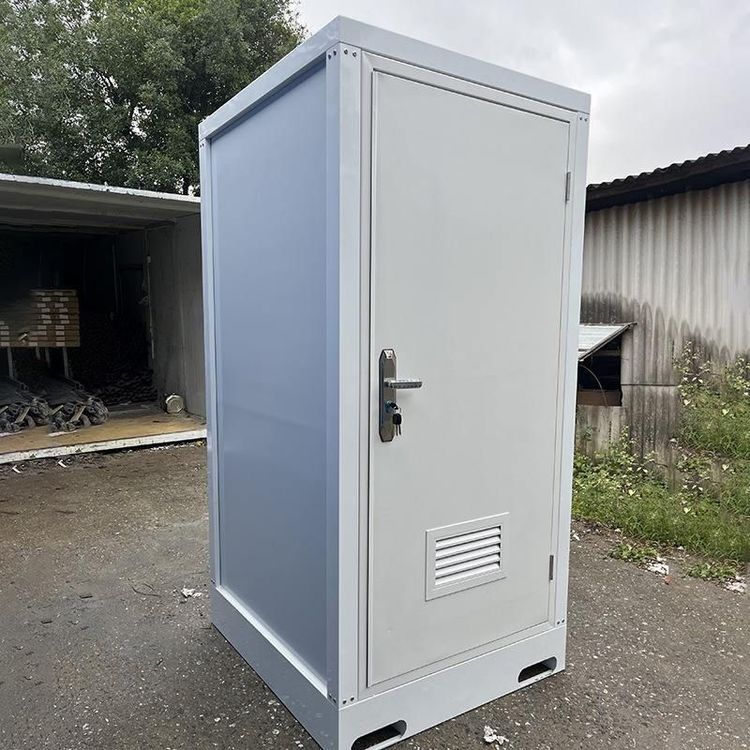
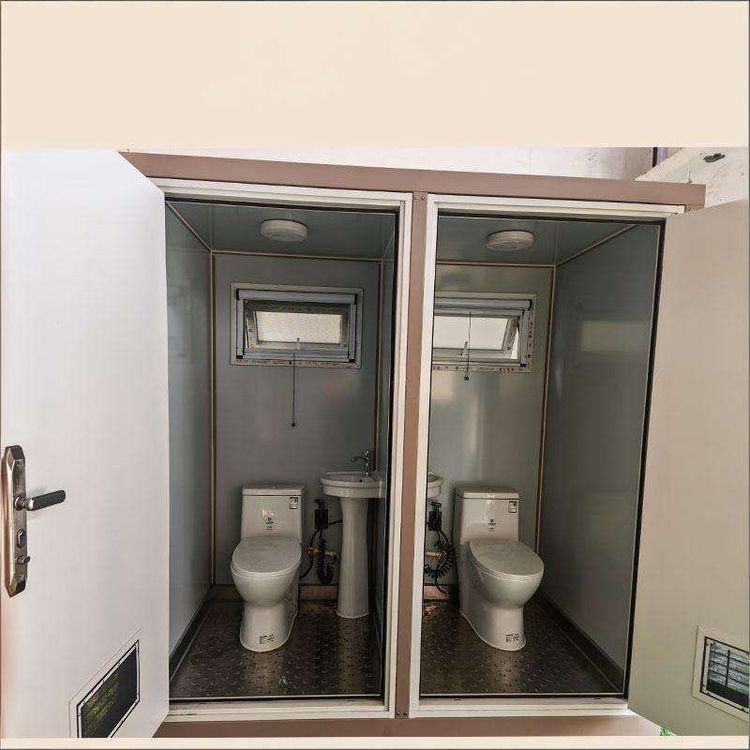
Chaoyang Prefabricated Mobile Toilet
The Chaoyang prefabricated mobile toilet is a modern public sanitation facility that integrates advanced technology with eco-friendly concepts, featuring cutting-edge technology, strong adaptability, and water-saving and environmental protection.

Outstanding technical features: It employs internationally recognized microbial toilet-specific technology, eliminating the need for water flushing and sewer connections. Through microbes cultivated by the Chinese Academy of Sciences, feces are decomposed, forming an ecological chain that achieves the crushing and digestion of feces. Smart microcomputer control requires no dedicated personnel for management, ensuring cleanliness, hygiene, and odor-free operation without clogging or leakage. Equipped with an automatic electronic ventilation fan that shuts off automatically upon departure, it also includes voice prompts, soft music, emergency assistance, music, and eco-friendly heating functions, enabling normal operation even at minus 30 degrees Celsius.
Wide range of applicable scenarios: Its compact size occupies minimal space, making it highly suitable for public places such as squares, tourist attractions, parks, and urban streets. It meets the urgent demand for mobile toilets during short-term events like sports competitions and exhibitions.
Significant water-saving and environmental protection: Although it does not require water flushing, it uses a new water source created by treating collected urine with deodorizers for flushing, achieving water conservation. Some models equipped with water circulation functions can achieve long-term use with a single water addition through multiple filtrations, with water-saving efficiency exceeding 80% of traditional flushing methods.
Excellent material and structure: The toilet body generally adopts fiberglass or polyethylene one-piece molding technology, offering corrosion resistance and complete sealing. Modular design facilitates transportation and deployment, with standard-sized units transportable by conventional freight vehicles and ready for use after simple pipeline connections and fixation on-site.
Superior environmental performance: Compared to traditional brick-and-mortar structures, it reduces carbon footprint by approximately 60% during the building material production stage and occupies less than 30% of the land area of fixed buildings. Its temporary nature provides flexibility in resource allocation, enabling reuse and reducing resource consumption caused by repeated construction.
Public health protection: The design strictly adheres to disease transmission control principles, with a negative pressure ventilation system preventing odor overflow and creating directional airflow to reduce the accumulation risk of microorganisms in enclosed spaces. Contact surfaces are treated with antibacterial agents, and some high-end models are equipped with touchless induction operating systems.
Comprehensive maintenance system: A professional service team employs a management model combining periodic inspections with real-time monitoring. Sensors continuously monitor key parameters such as fecal tank capacity and disinfectant levels, ensuring the facility remains in a usable state at all times.