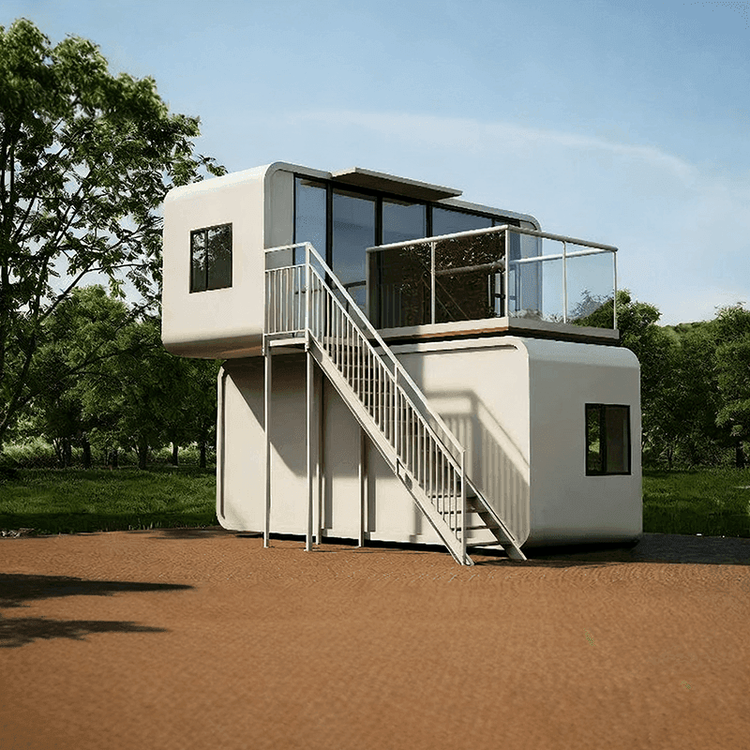
Cement Prefabricated House Three-in-One
The three-in-one cement prefabricated house typically refers to a layout with three bedrooms and one living room in a cement prefabricated house, suitable for small to medium-sized families.

1. Definition and Structural Characteristics
A three-bedroom, one-living-room cement prefabricated house is a residential form produced through factory-prefabricated components (such as walls, floors, beams, and columns) that are transported to the site for assembly. Its core material is cement, combined with steel reinforcement to enhance structural strength, forming a stable framework system. The three-bedroom, one-living-room layout is achieved through modular design, with clear functional divisions between bedrooms and the living room, high space utilization, and the ability to meet the daily living needs of small to medium-sized families.
2. Production Process and Economy
The production process for this type of house includes mold making, concrete pouring, curing, and on-site assembly. The molds are made of high-strength materials and can be reused 200-300 times, significantly reducing the cost per production. The prefabricated components are produced in a standardized manner in the factory, ensuring high quality control and reducing on-site construction errors, while also shortening the construction period by approximately 50% or more.
3. Performance Advantages
- Structural Safety: The composite structure of cement and steel reinforcement provides earthquake and compression resistance, capable of withstanding magnitude 8 earthquakes and strong wind loads.
- Durability: It has a fire-resistant rating of Class A, is moisture-proof and corrosion-resistant, with a designed service life of over 70 years and low maintenance costs.
- Energy Efficiency and Environmental Protection: The walls are filled with insulation materials to reduce energy consumption; factory production reduces on-site construction waste, meeting green building standards.
- Adaptability: Construction is not limited by seasons and can be carried out year-round; it supports overall relocation or secondary disassembly and assembly, with high resource reuse rates.
4. Application Scenarios
Three-bedroom, one-living-room cement prefabricated houses are widely used in temporary housing, post-disaster reconstruction, tourist resorts, and rural housing. Their rapid assembly characteristics are particularly suitable for projects with tight deadlines, such as emergency rescue and relocation or development in remote areas. Additionally, the modular design allows for expansion or adjustment of the layout according to needs, offering high flexibility.
5. Limitations
Despite their significant advantages, the initial investment cost of cement prefabricated houses is slightly higher than that of traditional brick-and-mortar structures, and long transportation distances may increase logistics costs. Furthermore, the space for personalized design is relatively limited, requiring local adjustments based on standardized modules.