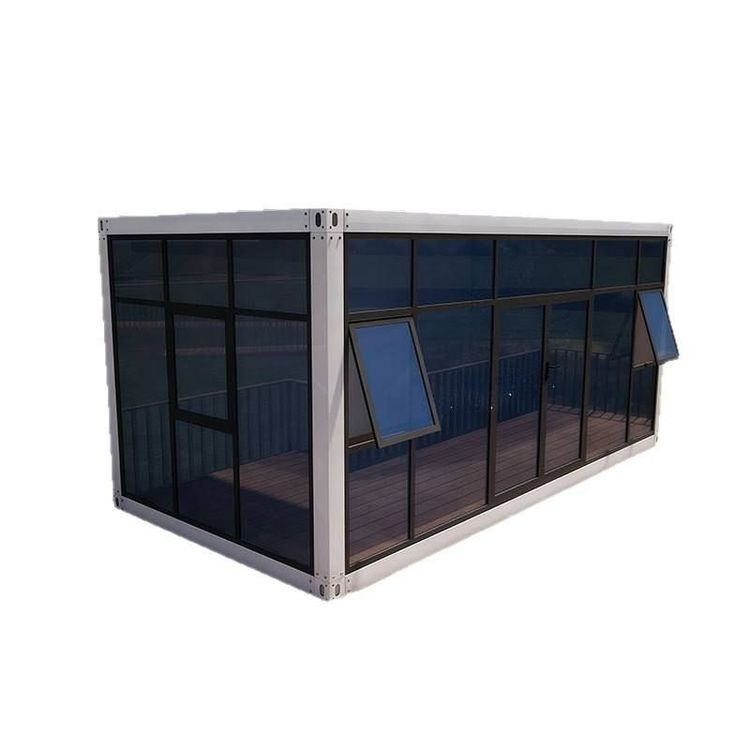
Building Houses in Containers
It is feasible to build houses in containers, and it has advantages such as flexible adaptability, controllable costs, and high construction efficiency. The following provides a detailed explanation from the aspects of technical feasibility, structural performance, application scenarios, and construction efficiency:

Technical Feasibility
Container architecture is a new type of building. By modifying and combining standard containers, houses that meet residential and office needs can be constructed. Although its development history is only about 20 years, the technology has gradually matured. Architects can use containers as basic modules, complete most processes such as the main structure, interior decoration, and mechanical and electrical pipeline layout in the factory, and then transport them to the site for assembly, completing house construction like building with building blocks. For example, the prefabricated "building-block houses" produced by China Construction Steel Structure Jiangsu Co., Ltd. for a North American project were shipped across the ocean in the form of four independent modules packed into containers and directly assembled on site to be delivered as fully furnished residential products that met local standards.
Structural Performance
Container houses can meet the needs of different scenarios in terms of structural performance. Under extreme working conditions, some high-quality container houses demonstrate good wind and earthquake resistance. For example, the packing-box units of Suzhou Zhongnan Steel Structure Co., Ltd. adopt a full steel structure frame. The measured wind resistance level reaches 12, and the earthquake resistance level is 8. The frame deformation rate is only 0.18%, far lower than the industry's qualified threshold of 0.3%.
Application Scenarios
Container houses have a wide range of applicable scenarios, including temporary offices, accommodations, event support facilities, engineering camps, temporary government and enterprise buildings, and commercial pop-up stores. For example, in the engineering camp scenario, the quick-assembly boxes of Suzhou Zhongnan can be installed in just 2 hours per set and support on-demand assembly and combination. Ten standard dormitories can be built within one day. Their packing-box units have completed interior decoration and facility pre-installation before leaving the factory and can be put into use immediately after on-site hoisting, making them suitable for long-term on-site projects.
Construction Efficiency
Compared with traditional construction methods, the construction efficiency of container houses is significantly improved. Factory-based operations enable most processes to be completed in the workshop, improving the precision of product quality control and reducing the time and difficulty of on-site construction. For example, in a 18-story high-rise residential project in Hong Kong, China Construction Science & Technology adopted a modular construction plan and completed delivery within one year. The overall construction period was shortened by 60% to 70% compared with local traditional construction methods.