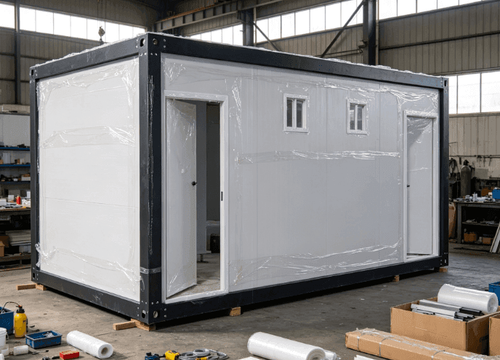
2023 Mobile Toilet
In 2023, mobile toilets exhibit diverse characteristics in terms of application scenarios, product types, industry issues, and development trends.

Expansion of Application Scenarios
In 2023, the application scenarios of mobile toilets have further expanded. Taking the scenic area along the Yellow River in Lanzhou as an example, mobile toilets have been gradually installed and put into use, effectively alleviating the toilet shortage for tourists in the scenic area. Such scenarios typically require a balance between environmental harmony and ease of use. The modular design of mobile toilets enables rapid deployment in natural landscapes or urban public spaces, meeting both temporary and long-term needs.
Product Types and Price Tiers
Mobile toilets come in a rich variety of types with a wide price range:
- Basic Models: Priced between 300 and 1500 yuan, these are mostly metal-cased and commonly found in cost-sensitive scenarios like construction sites, with basic excretion functions.
- Mid-to-High-End Models: Priced between 2000 and 9000 yuan, these are equipped with showers, deodorization functions, etc. Connected toilets in scenic areas cost around 5000 yuan, balancing practicality and comfort.
- Smart and Eco-Friendly Models: The price is not specified, but referencing Kohler's non-mobile smart toilet (22,999 yuan), it can be inferred that the cost is relatively high, potentially integrating advanced technologies such as automatic monitoring and ion deodorization.
The rental market also features tiered pricing: basic models cost 50-100 yuan per day, connected toilets for large events cost 150-300 yuan, and high-end models (including sinks and lighting) cost 300-500 yuan, with discounts of 8-9% for bulk rentals.
Industry Issues and User Experience
Some event organizers reduce costs by configuring the minimum number of toilets, leading to an imbalance between supply and demand. For example, the phenomenon of public urination at the 2023 Beijing Marathon exposed the industry's neglect of user experience. This issue reflects a lack of scientific calculation during the planning phase, failing to fully consider factors such as pedestrian density and usage duration. There is an urgent need to optimize configuration through standardized processes or intelligent prediction tools.
Development Trends: Intelligence and Experience Upgrade
Smart toilets are becoming the future direction:
- Technology Popularization: The smart restrooms at Fuzhou Airport can automatically monitor ammonia concentration, and the public toilets at Wuxi Station use ion deodorization technology, reducing complaint rates by 90% and labor costs by 70%. As the technology matures, costs are expected to decrease, promoting the penetration of smart toilets from high-end scenarios to universal applications.
- Experience Optimization: Urban smart public toilet stations achieve a transformation from 'functional satisfaction' to 'experience optimization' by adding air quality sensors, pedestrian density algorithms, electronic guidance screens, etc. They also provide data-driven operation and maintenance support for managers, enhancing urban public service levels.