
Top Portable Toilet Movable Manufacturers: How to Choose a Factory Partner
When selecting a factory partner among top portable toilet movable manufacturers, a comprehensive evaluation should be conducted from dimensions such as structural craftsmanship, installation efficiency, internal configuration, customization capabilities, and after-sales support.
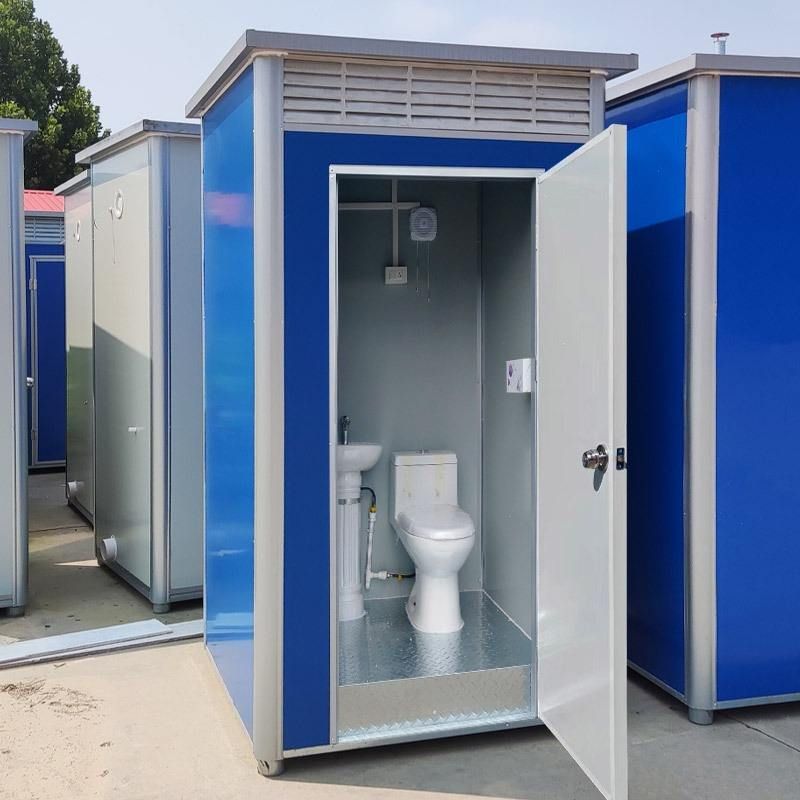
1. Structural Craftsmanship and Durability
The durability of portable toilets directly depends on the design of the main structure and anti-corrosion treatment. It is necessary to confirm whether the main body is prefabricated with an integrated steel structure, giving priority to hot-dip galvanized steel or stainless steel materials, and requesting the provision of material thickness parameters (e.g., a galvanized layer thickness of ≥80μm) and details of the anti-corrosion process (such as the sandblasting derusting grade and spraying process). For example, some manufacturers can significantly extend the product lifespan to over 10 years by increasing the wall thickness of steel components (≥3mm) or adopting double-layer anti-corrosion coatings. Material certificates and sample cross-section verification are crucial to avoid using easily rusted materials such as ordinary cold-rolled steel.
2. Installation Efficiency and Site Adaptability
The degree of factory prefabrication determines on-site construction efficiency. It is advisable to prioritize products with modular designs, whose bolt-connected structures reduce welding procedures and, when combined with built-in chassis and roof systems, eliminate the need for on-site foundation pouring. For instance, some manufacturers claim that their products can be assembled by two workers in four hours, making them suitable for emergency projects or temporary public facilities. It is essential to clarify the product's requirements for the foundation (e.g., whether a hardened ground is needed) and whether it offers adaptation solutions for different terrains (such as slopes or soft soil).
3. Internal Configuration and User-Friendly Design
Basic functions should include sinks, mirrors, flushing systems, and ventilation and lighting, while also evaluating the richness of optional configurations. The ability to add barrier-free facilities (such as handrails and non-slip floors) and mother-and-baby facilities (such as nursing tables and baby changing stations) are important indicators. For example, some manufacturers offer adjustable-height sinks or emergency call buttons to meet the needs of special populations. It is necessary to confirm whether the configuration complies with local health standards (such as sewage discharge methods and water tank capacity).
4. Customization Capabilities and After-Sales Support
Manufacturers should have the flexibility to adjust according to site dimensions, colors, and functional requirements, such as offering customization of non-standard sizes or brand-color spraying services. The cross-regional after-sales response speed (e.g., on-site maintenance within 48 hours) and spare parts supply capabilities directly affect long-term usage costs. Avoid selecting manufacturers that only pursue low prices while ignoring configuration rationality, such as those that result in inflated costs due to over-design or those with insufficient basic configurations that lead to soaring post-maintenance expenses.
By systematically evaluating the above dimensions, high-quality, durable portable toilet manufacturers that meet actual needs can be selected, ensuring that the products are suitable for long-term use in different scenarios.



