
Shared Mobile Toilet
A shared mobile toilet is a facility that can be moved as a whole and placed in fixed or temporary locations to provide toilet services for the public and customers. It is suitable for public places such as stations, docks, tourist attractions, construction sites, and squares.
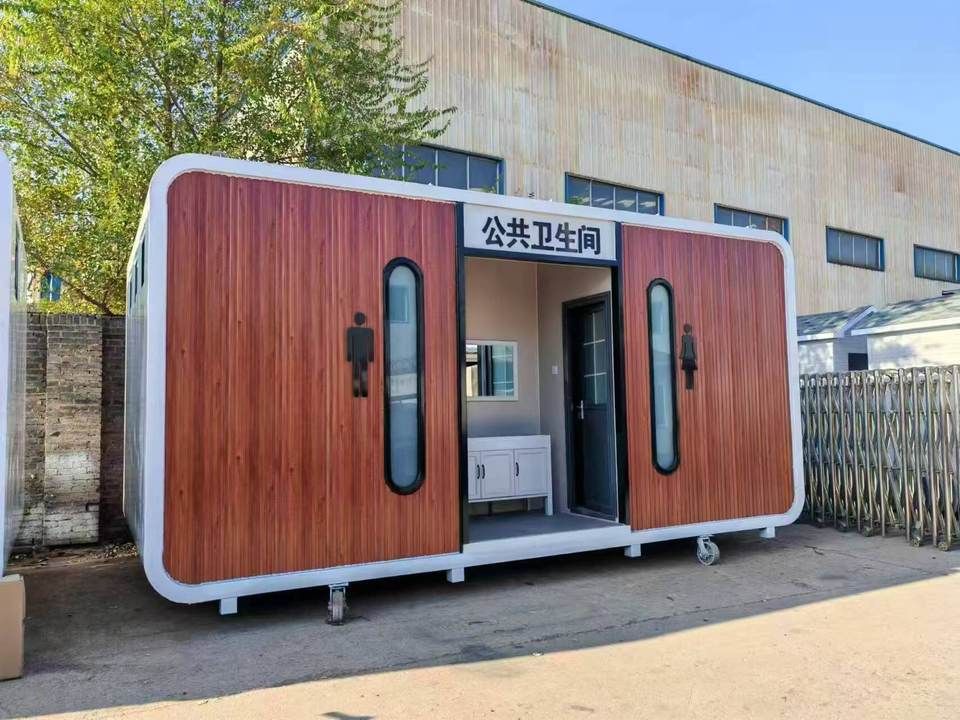
I. Structure and Moving Methods
There are two types based on structural form: Single-unit mobile toilets are usually independent units, suitable for scenarios with limited space or scattered demands; Composite-structure mobile toilets are composed of multiple units and can flexibly expand capacity to meet the needs of high-traffic areas. Based on moving methods, lifting and handling types rely on lifting equipment for overall lifting and are suitable for places that are fixed for a long time but need occasional relocation; powered and towed types are equipped with power systems or towing devices and can be quickly moved by vehicle traction, suitable for temporary events or emergency scenarios.
II. Sewage Treatment Technologies
- Water-flush and non-water-flush suction types: Collect excreta through water flushing or vacuum suction and require regular connection to sewage pipes or suction trucks for cleaning. They are suitable for areas with municipal infrastructure.
- Recirculating water-flush type: Equipped with intermittent aerobic and anaerobic treatment devices, biological bacteria are added to decompose organic matter. The treated water can be recycled for flushing, with only 0.46 liters of water per flush per person, significantly saving water resources.
- Dry-packing type: Uses biodegradable plastic bags to collect excreta. After use, the bags are automatically replaced and collected centrally, requiring no water flushing. It is suitable for water-scarce areas or areas with high environmental protection requirements.
III. Materials and Configurations
For exterior wall materials, options include color-coated steel plates, metal carved plates, and stainless steel plates, which offer both corrosion resistance and aesthetic appeal. The main structure is made of national-standard light steel keel welding to meet the strength requirements for overall lifting. Standard configurations include toilets, lighting fixtures, and exhaust fans, with optional equipment such as heating and cooling air conditioners and air purifiers to enhance user comfort.
IV. Barrier-Free Design
To meet the needs of special groups, barrier-free shared mobile toilets are designed as small spaces that are wheelchair-friendly and unisex. Inside, they are equipped with toilets and safety grab bars. The wheelchair turning diameter is not less than 1.5 meters, and the area should not be less than 4 square meters. They are also equipped with facilities such as washbasins, clothes hooks, and call buttons to ensure safety and convenience in use.



